

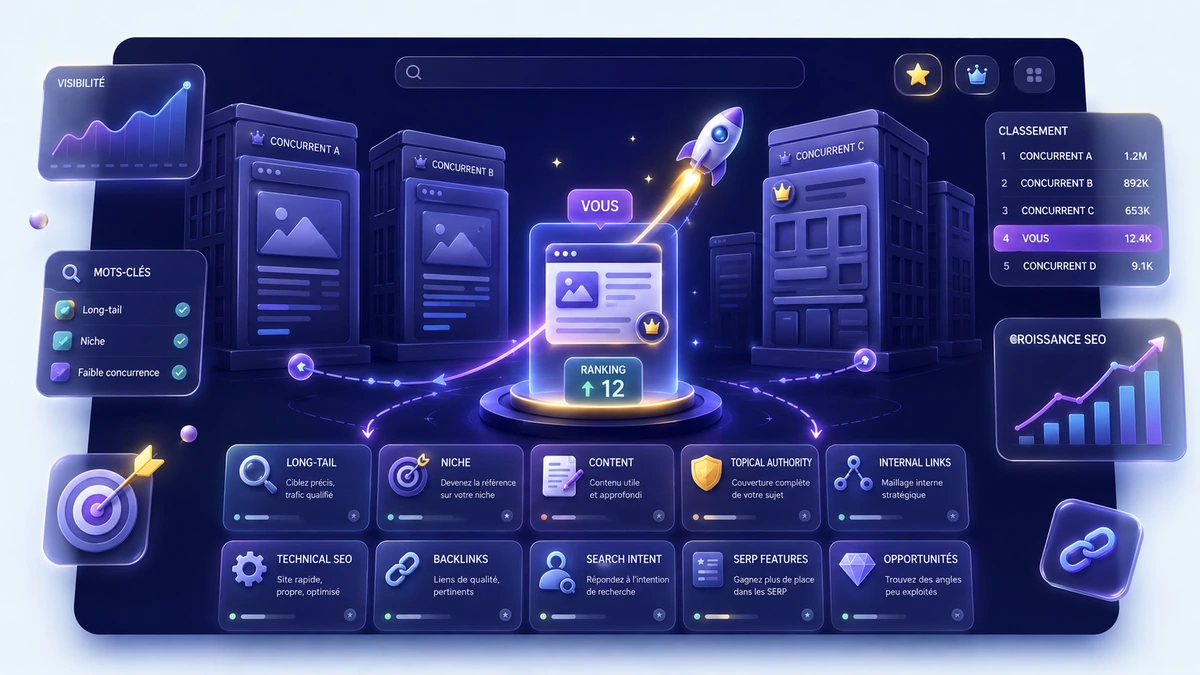
Steal SEO traffic from market leaders The boarding guide bottom of the funnel
5 concrete strategies to siphon traffic and brand awareness from your competitors, even if your brand is less known. Particularly effective for SaaS B2B.
The problem: you are facing giants
You have a B2B SaaS, an online service, or an e-commerce business. Your competitors have raised millions, spent fortunes on branding, and flooded the market with their names. The result: When a prospect types a query into Google or ChatGPT, they're the ones who show up first.
This is a classic scenario, especially in the B2B SaaS world where fundraising leads to massive investments in brand awareness. These companies build strong brands, accumulate domain authority, and become almost indispensable for generic industry search queries.
The good news is that their size is also their weakness. These big brands generate a huge volume of «brand» queries that you can intercept with the right strategies.
In this article, we present 5 concrete and actionable levers to hijack your competitors' notoriety, position yourself on low-funnel, high-purchase-intent keywords, and turn this asymmetry into a competitive advantage.
The 5 strategies for siphon traffic of your competitors
«Reviews»
Intercept your competitors' leads at the exact moment they hesitate to buy. High volume, maximum purchase intent.
«Alternatives» Queries»
Capture dissatisfied users or those in the benchmark phase. Less volume, but exceptional traffic quality. Also powerful in GEO.
Pages «VS»
Compare leaders with each other and jump into the conversation. Perfect for SEO and for being cited by LLMs.
Zero volume keywords
Discover underserved niches by deriving your keywords by sector or feature. No competition, qualified traffic.
Trendjacking
Surf emerging trends in your industry before the big players react. The flexibility of the small against the inertia of the big.
Where do these strategies fit into the sales funnel?
The strategies presented here primarily target the middle and bottom of the funnel, where purchase intent is strongest.
Queries «Reviews»: Intercept Buyers at the right time
When a user types [Brand] notice In Google, he's about to buy. He's heard of the product, he may have already visited the site, and he's looking for confirmation before taking the plunge. This is the perfect time to intervene.
⚡ Examples of queries to target
Pennylane review · Qonto review · LegalPlace review · Indy reviews · Dext advice · Payfit reviews · Spendesk reviews
The principle is simple: you create a complete and honest review page about your competitor's brand. You detail their strengths, limitations, and use cases. At the end, you propose your solution as an alternative. Prospects arrive to learn about your competitor and leave knowing about your product.
Why did it work
The user is in the middle of a decision-making process. They want outside opinions, not the brand's marketing spiel. If your page is well-constructed, detailed, and credible, it will naturally rank because Google values third-party content for review queries.
Points of attention: These queries are historically dominated by affiliate sites. They defend them tooth and nail because it's their core SEO business. Therefore, very high-quality content is needed to surpass them, and netlinking on these pages should not be neglected.
The ideal structure of a «Testimonials» page»
Factual presentation of the solution
Detail the features, pricing, and use cases. Be precise and honest, as this builds credibility.
Strengths and weaknesses
List the advantages and limitations. Being objective makes you trustworthy in the eyes of readers and search engines.
Your verdict and your alternative
Provide your synthesized opinion, then present your solution as a complementary option or superior in certain aspects.
CTA to your product
Include a clear call to action that redirects to your sign-up or demo page.
Do you want to implement this strategy in your market? We can help you identify and target the right branded keywords.
Make an appointment»«Alternatives» Queries capture unmet demand
Query types [Brand] alternative are a strategic goldmine. When someone is looking for an alternative, it means they already know the competitor but aren't fully convinced. They're looking for something different: cheaper, with other features, better support.
⚡ Examples of queries to target
PennyLane alternative · Qonto alternative · Monday alternative · HubSpot alternative · Notion alternative
✓ Advantages
Very high purchase intention. Visitors are in an active benchmarking phase and are open to discovering new solutions. Also works in GEO: ChatGPT picks up these pages when asked for alternatives.
Limits
Research volumes are lower than on «review» queries. Affiliates are also present on these queries. Rich and structured content is necessary to rank.
The format that worked: the Top 10
The ideal format for «alternative» pages is a ranking. You create an article like «Top 10 Best Alternatives to [Brand]» and position your solution in first place. Behind that, you list the 9 most legitimate players in the market.
Double Impact SEO + GEO: Listicle-style «alternatives» pages are exactly the type of content that ChatGPT, Perplexity, and other LLMs will pull when a user asks «What are the alternatives to [Brand]?». By ranking first, you maximize your chances of being cited by AI.

Be quoted by ChatGPT, Perplexity, and Gemini
60%: Some searches don't require a click. You are selected by AI.
Pages «VS»: placing oneself in each comparison
Query types [Brand A] vs [Brand B] exploding in popularity, especially since the rise of ChatGPT and conversational engines. Users are actively comparing solutions and want data, comparison tables, and decisive verdicts.
⚡ Examples of queries to target
Dext vs. PennyLane · Colts vs. Eagles · Monday vs. Asana · Notion vs. ClickUp · Qonto vs. Shine
A good landing page follows a precise structure that maximizes both SEO and conversion:
Introduction contextualizes
Explain the market context and why these two solutions are often compared.
Individual presentation of each solution
Detail the features, pricing, strengths, and weaknesses of each.
Comparison table structure
A clear table that compares point by point: features, price, support, reviews, etc.
Verdict + mention of your solution
Provide a transparent verdict, then mention your solution as a third recommended option.
Here is an example of a comparative table structure to integrate into your VS pages:
| Criteria | Solution A | Solution B |
|---|---|---|
| Price / month | From €29 | From €49 |
| Free trial | 14 days | 30 days |
| Integrations | +200 apps | 150+ apps |
| Client support | Chat + Email | Chat, Phone, Email |
| G2 note | 4.3/5 | 4.5/5 |
| Our recommendation | Your Solution – The best quality/price compromise with responsive support | |
This is the key to VS pages: even if you're comparing two competitors, you need to mention your solution in a strategic spot on the page. For example, after the verdict, add a paragraph like:
💡 Strategic placement
«If neither of these two solutions is perfect for you, we also recommend [Your Brand] who offers [key benefit] at a more competitive price.»
The objective is twofold. First, LLMs like ChatGPT will detect this recommendation and can bring it up when a user asks the question. Second, human visitors who land on your page discover your solution as a third option.
Do you want to implement these strategies?
We help B2B SaaS companies siphon traffic from their competitors with custom SEO and GEO strategies.
Let's discuss your project»The conversion technique of «artistic blur»
Here's a slightly bolder technique that applies to all review, alternatives, and VS pages. The idea is simple but remarkably effective: place a generic CTA without specifying which solution it redirects to.
Concretely, on your «[Competitor] reviews» page or your VS page, you add a button «Create my account» or «Start for free» without mentioning your company name. The visitor, who is in the discovery phase of the competitor's brand, clicks and lands on your signup page.
What it brings
More people are entering your acquisition funnel. As these visitors are at the bottom of the purchase funnel, the final conversion rate remains acceptable despite a higher than normal bounce rate.
✗ The limits
Less qualified traffic because some users expected to land on the competitor's site. Higher bounce rate on the funnel. It's a borderline user experience approach that needs to be accepted.
Use with discretion. This technique generates volume in your funnel, but the traffic quality is lower. Reserve it for markets where volume takes precedence over qualification, and where your funnel is robust enough to filter out unqualified users.
Keywords with zero volume Find your SEO niche
Keyword tools show «0 volume» for a query? That doesn't mean no one is typing it. The tools have between 3 and 12 months of latency. And above all, a highly targeted query with 20 searches per month can generate much more qualified leads than a generic query with 10,000 searches.
The principle is simple: deploy hyper-targeted content around your core business, your specific use cases, and your strong differentiation. The objective is to explore, find what works, then replicate.
⚡ Concrete example
If you are accounting software specialized for architects: best accounting software for architects · Architect invoicing software · Architect quote software
The two derivation models
Simulate possible derivations for your market
✓ Advantages
No SEO competition. Ultra-qualified traffic. Strengthens your industry expertise and backlink profile. Powerful for semantic cocooning. Allows discovery of outperforming patterns.
Limits
It generally requires 6 months of exploratory production before finding a niche that performs well. When a competitor detects the pattern, they can easily enter the market due to low competition.
Synergy with netlinking: If, for example, you work a lot with architects, you will naturally get backlinks from architecture-related sites. This semantic consistency between your content and your link profile considerably strengthens your authority on these niche queries.

Boost your authority with premium backlinks
Targeted strategy, optimized anchors, measurable ROI.
Trendjacking surf the trends before the others
The latest strategy leverages the main advantage of small players: agility. While a large company plans its editorial calendar over 12 months, you can publish optimized content in a few days on an emerging trend.
Trendjacking is taking a nascent sector trend (new product, new regulation, new technology, buzz) and producing optimized content before others jump on it.
⚡ Real-life example
In the CBD sector, trendjacking on gummies and new molecules allowed [companies/people] to ride very lucrative trends by positioning themselves ahead of major affiliate sites.
How to detect trends
Monitor Google Trends
Set up a watch on your topic with a filter for the last 1 to 3 months in your country. Identify rapidly growing topics.
Analyze the blind spots of tools
Keyword research tools have 3 to 12 months of latency. If a trend appears on Google Trends but doesn't yet have volume in Ahrefs or SEMrush, that's the ideal signal.
Produce quickly
Publish optimized content in days, not weeks. Speed is your competitive advantage against the big players.
Consolidate your position
If the content performs well, strengthen it with internal linking, backlinks, and regular updates to maintain your lead.
✓ Advantages
First come, first served. No initial competition. Big players take months to react. Allows you to discover new queries and intentions before others.
Limits
Not all trends turn into sustainable volume. It requires active monitoring and responsive production capacity. The major players will eventually enter the market.
Query Generator: Test with your competitor's name
Enter the name of a competing brand to generate strategic queries to target
Ready to take action?
At Astrak, we help ambitious companies compete with much larger players in SEO and GEO. Let's discuss your strategy.
Book a free appointment»