

Trust Flow is a metric developed by Majestic who evaluates the quality of links pointing to your site. However, this metric can be manipulated to increase the price and quantity of your sponsored articles.
In this article, we'll show you, using our example on manipuleo.com, how to manipulate Trust Flow to maximize your results. Discover how to boost the value of your links on platforms like Rocketlinks thanks to Trust Flow!
Why is Trust Flow an important indicator for link building?
Google places great importance on the quality of incoming links when determining a website's authority. It favors sites that receive high-quality links to show that the content is relevant. Thus, a good Trust Flow on Majestic indicates that reliable sources link to your site, which enhances your credibility in Google's eyes.
But the impact of Trust Flow doesn't stop there! Buyers prefer to invest in sites with a high Trust Flow to guarantee an effective netlinking strategy. A link that comes from a site with a good Trust Flow is more effective at improving rankings in search results.
You may have quickly understood... A high Trust Flow increases the price of your backlinks and boosts your margins because they are of better quality. It may therefore be interesting to manipulate the Trust Flow.

Boost your authority with premium backlinks
Targeted strategy, optimized anchors, measurable ROI.
Case study: Manipulating Trust Flow on manipuleo.com
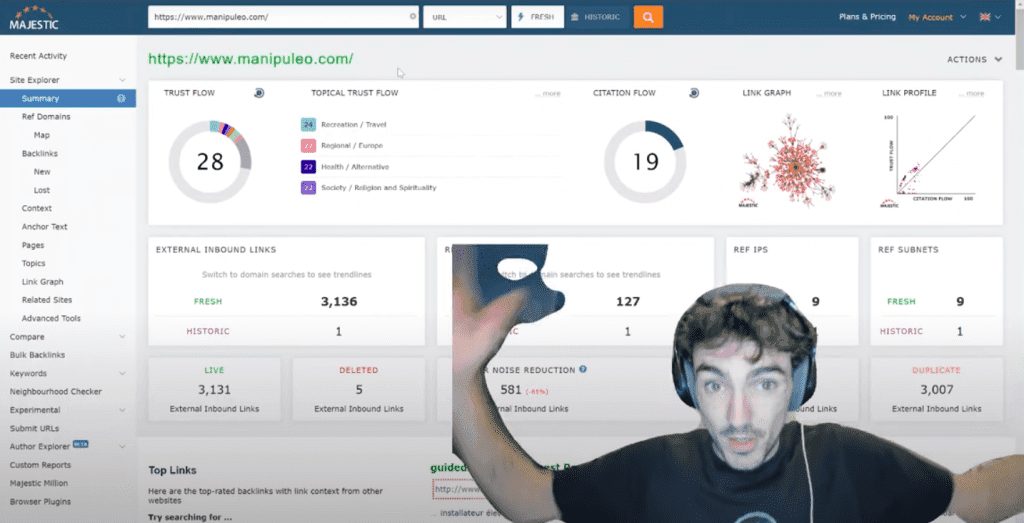
We will see how I managed to manipulate Trust Flow with a score of 26 for my site manipuleo.com. The Trust Flow is higher than the Citation Flow (CF) with a ratio of 1.5. A TF higher than CF indicates that the netlinking was done well.
This performance can be explained by our strategy of manipulation Trust Flow with 127 referring domains pointing to the home page. The URLs redirecting to our page have a Trust Flow between 21 and 40, which gives significant power to my site.
To manipulate the CTR, all I had to do was go to Fiverr and buy a service which allowed for an increase in TF on Majestic.
How to increase Trust Flow on Majestic?
Acquire high-quality, thematic links
A quality thematic link comes from a site whose content is related to your site's content. This means that not only does the link come from a trustworthy source, but it is also relevant to your niche.
Ensure that links are naturally integrated into the content, rather than forced. A good link should fit logically into the context of the article and add value for the readers.
How to spot good quality links?
A good starting point is to analyze a site's topical trust flow via Majestic to target themes similar to yours. Also, look at the trust flow specific to the URL, as some can offer more «weight» than others. Remember, Google values quality over quantity. Don't just focus on high TF or CF. However, establish thematic links with sites whose authority is similar to yours.

«Trust flow» is also an indicator to watch, but you should remain wary because it is easy to manipulate!
Also check the link history! Use the Wayback Machine to view the history of sites. This tool shows whether a site has maintained good content quality over time. This helps to ensure that the site has not been involved in spammy practices or changed topics, which could negatively affect the link's value. Additionally, tools like SEMrush will help you examine a site's traffic history.
Regarding acquisition strategies, the least risky are the Link exchanges or the collaborations with sites in the same niche. However, remain vigilant to ensure these exchanges remain relevant and are not perceived as manipulative.
Advice: Diversify your anchors and spread link distribution over time.
Buying backlinks can be risky. Search engines penalize unnatural link purchases.
Advice: If you choose this path, be sure to diversify link attributes (REL tags like dofollow, nofollow, sponsored, and UGC). Avoid overly optimized anchors to maintain a natural look. Also, spread out the distribution over time.
How to avoid low-quality links in SEO?
Every SEO expert knows that not all links are created equal. Take, for example, links from forums and directories. This type of strategy, often integrated into what is called « ninjalinking », can be quite risky. Why? Because the quality of links varies and managing them can quickly become a headache. These types of links can quickly lose their effectiveness.
Suppose you obtained a link from a popular directory. Initially, this link is on a page that ranks well on Google, thanks to the directory's good reputation and Trust Flow. Let's say this page has a TF of 30, a high score signifying strong credibility in Google's eyes. Over time, the directory continuously adds new links and content. Your link, initially on the first page, is pushed to pages less valued by Google with a TF below 30. Another issue is to avoid saturating these directories to prevent falling into spamming.
Advice: Therefore, it is important to’spread the creation of these links over time to simulate natural growth. Google is not fooled and can easily detect and penalize abusive practices.
Also pay attention to links coming from networks of sites or those that seem «spammy»!
When discussing website networks in link building, it's common to buy expired domain names. The benefit is to capitalize on their SEO authority and republish old content. This practice is risky, especially if detected by search engines.
Advice: Diversify web hosts and IP addresses for each site. This masks single site management to reduce the risk of detection. If uncertain about these techniques, it is recommended to consult an SEO expert.
Finally, don't forget to regularly clean up your link profile via Search Console to remove low-quality backlinks.
Produce credible and relevant content
Another way to improve your site's trust flow is to produce credible and relevant content..
To begin, it is essential to look at what your competitors are doing on the SERPs for the same queries. Carefully analyze their content, identify the themes they cover and the questions they answer. This will not only allow you to align with user expectations but also to find ways to add value.
Next, analyze the topics covered and search intents on the SERP. Are users looking for detailed information, product comparisons, expert reviews, or practical guides? By precisely meeting these expectations, you will better capture their attention and trust.
Check the traffic potential of a keyword. Use tools like Semrush, Ahrefs to assess search volume and keyword difficulty.

Finally, ensure your content is well-structured and engaging, while also providing real added value. Consider enriching your content with videos, infographics, or case studies.
What is the difference between Citation Flow and Trust Flow?

Citation Flow and Trust Flow are two metrics developed by Majestic SEO that measure different aspects of backlinks.
Citation Flow focuses on the quantity of a site's backlinks, while Trust Flow is a score from 0 to 100 that evaluates the quality of those backlinks.
For an optimal SEO strategy, you need a good balance between Citation Flow and Trust Flow to ensure link popularity and quality.
In general, for a good link-building strategy, Trust Flow should be higher than Citation Flow.
For example, a site with a Citation Flow of 30 and a Trust Flow of 40 shows a good balance. This indicates that the site not only has many backlinks, but also that these links are of high quality.
Conversely, a site with a Citation Flow of 50 but a Trust Flow of only 10 presents a poor balance. This suggests that while the site has many backlinks, most of these links are of low quality.

FAQ on Trust Flow Management
What is the score of a good Trust Flow?
A good Trust Flow has a score greater than or equal to 30.
What are the risks associated with manipulating Trust Flow?
Our analysis indicates that Google tends to filter out low-quality links rather than directly penalizing sites.
Can manipulating Trust Flow improve a site's ranking in search results?
No, manipulating Trust Flow does not improve a site's ranking in search results. On the other hand, it allows’improve the sale price of links.