


Do you think SEO is dead with the arrival of ChatGPT and Gemini? Wrong. It's evolving. If you want your content to be picked up by Artificial Intelligences (AI), you need to stop writing for Google like you did in 2010.
LThe key now lies in the authority of your brand and the raw structure of your data.
There is massive overlap between classic SEO and what is now called GEO (Generative Engine Optimization). Websites that perform well on Google are often those that feed LLMs. But be careful: to become a «Tier 1 Source» (a trusted source that AI systematically cites), you must radically change the way you structure information.
What to remember for your GEO strategy in 2025
LLM optimization is not a separate discipline. It's SEO. more strict, more technical, and more structured.
To win, you must apply three fundamental principles:
1. Simplify to the extreme
Short phrases, active voice, information at the beginning of sentences (this is the inverted pyramid principle). AI doesn't have time for your complex sentence structures.
2. Structure your data
Abuse of JSON format and bulleted lists. It's the language robots understand best.
3. Credibilize your entity
Work on your branding and connect your entities via the schema.

Be quoted by ChatGPT, Perplexity, and Gemini
60%: Some searches don't require a click. You are selected by AI.
1. The New Metric: «Information Recovery Cost»
Forget Google's «Crawl Budget» for a moment. For LLMsLarge Language Models), the new major constraint is the Information Retrieval Cost (Cost of information retrieval).
AI systems process millions of pages. For them, finding precise information in «wordy» content is like searching for a needle in a haystack. Each «token» (each piece of a word) costs them money in computing power.
Your mission is simple: Reduce this cost for AI.
- Be directTo the point) : AI hates unnecessary talk. It wants raw information, without superfluous literary flair. If you beat around the bush, you lose relevance points.
- Structure info : If AI has to «think» to understand your sentence or the link between two ideas, it will move on to a simpler source to digest.
💡 My tip: Écrire « droit au but » sans fioritures améliore non seulement ta compréhension par les IA, mais c’est aussi devenu un signal positif pour Google. Le moteur recherche désormais la satisfaction immédiate de l’utilisateur.
2. JSON is the ultimate fuel for LLMs
If there's one technical gem to take away from my video, it's this: LLMs are addicted to JSON format. It's literally their preferred format for structuring data.
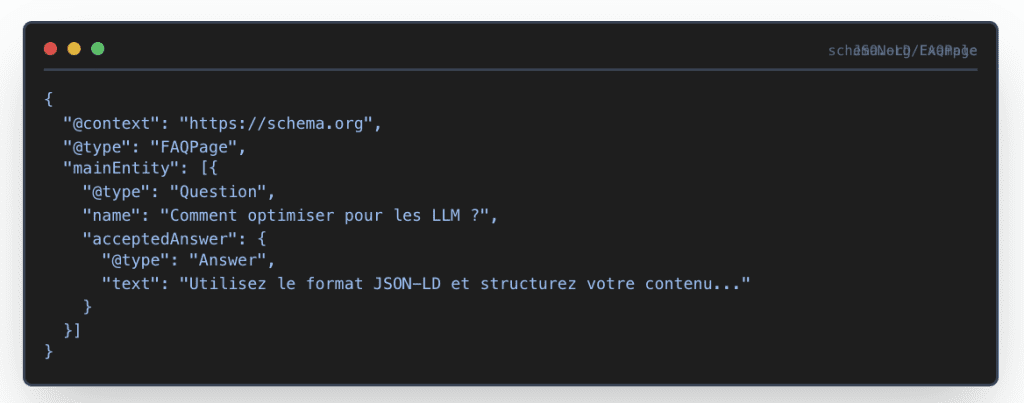
Structuring your data, especially your FAQs, in JSON format considerably facilitates the ingestion of your content by models like GPT-4, Perplexity, or Claude.
How to apply it concretely?
1. FAQ in JSON-LD
Stop settling for simple plain text Q&A in your articles. Use structured data markup (Schema.org) for your FAQs.
2. Ping-Pong«
Prioritize short questions followed by short, factual answers. This format is ideal for being «ingested» and presented as-is in a chatbot response.
3. Pages «Chunky» (easy to extract)
A page dedicated to a specific intent, coded cleanly without superfluous scripts, will always be preferred over a complex 5000-word guide that mixes everything.
3. Becoming a «Tier 1 Source»: The Authority Strategy
Have you noticed that ChatGPT often cites the same websites? It's no accident. It works with a hierarchy of sources, highlighted by Surfer SEO studies:
1. Tier 1 Sources (Core Sources)
Les sources de confiance, récurrentes, qu’il considère comme « la vérité ». Elles apparaissent systématiquement.
2. Tier 2 Sources
Les sources volatiles qu’il utilise pour compléter, mais auxquelles il accorde moins de poids.
For your site to become a Tier 1 source, you must prove your semantic authority and your existence as a real entity in the eyes of the Knowledge Graph.
Build your «Social Fortress»
AIs check your credibility through external signals. That's what I call building a fortress.
Real User Signals: AI (and Google) favor sites where real humans spend time and navigate. Real traffic lends credibility to the source.
Active Social Networks: An active LinkedIn account, an updated Google Business Profile, or an engaging Twitter profile validate your existence. LinkedIn is, moreover, a massive data source («corpus») consumed by AI.
The diagram sameAs : It's technical but crucial. Use this Schema.org tag in your site's code to explicitly tell the bots: «My website, this LinkedIn page, and this Wikipedia entry are all the same entity.». This connects the dots of Knowledge Graph and strengthen your authority.
4. Advanced (and «Gray Hat») Techniques for Influencing AIs
Le Chiang Mai SEO 2025 a aussi révélé des méthodes beaucoup plus agressives pour manipuler les résultats des IA. Je te les partage à titre informatif (à utiliser avec prudence et éthique, on est d’accord ?).
- «Parasite SEO» on LinkedIn: Since AIs trust LinkedIn, publishing optimized content (via Pulse articles or long posts) allows you to quickly position yourself in chatbot responses by «parasitizing» LinkedIn's domain authority. I've personally used this technique to clean up the online reputation of some clients.
- Influence by foreign media: Using trusted media in other countries (that speak the same language) to push information can influence the overall perception of the model. It's cheaper and sometimes more effective than trying to influence Le Monde or Le Figaro.
- The «DMCA Takedown»: It's radical. Some SEO experts have managed to make entire entities (like public figures) disappear from AI memory by sending massive copyright (DMCA) requests. If the AI can no longer read the source, it forgets the information.