

Build his
Web Authorities
In 2026
Knowledge Graph, Named Entities & GEO: The complete system to exist in Google AND in generative AI responses.
Boost your authority with premium backlinks
Targeted strategy, optimized anchors, measurable ROI.
Why is it critique now
We live in a world of dual search. On one hand, classic Google with its blue links, on the other, generative AIs: ChatGPT, Perplexity, Gemini, Claude. And these AIs cite on average only 2 to 7 sources per response, compared to 10 blue links on Google. The competition to be cited has never been fiercer.
(vs 10 blue Google links)
Semrush Study, June 2025
ChatGPT / AIO / Perplexity
come from Wikipedia
Most Cited Sources by LLMs in 2025
Important nuance: ChatGPT a une preference forte pour Wikipedia (47,9% de ses top citations selon Profound). Google AI Overviews et Perplexity preferent Reddit. ChatGPT est devenu la source #1 de trafic vers Wikipedia en juin 2025 (Similarweb). Reddit domine globalement grace a son accord de licence de 60M$ avec Google en 2024.
Two systems Complementary
To build authority with Google and AIs, you need to understand and work on two distinct mechanisms. It's by combining them that you get the best results.
System 1: Entity & Knowledge Graph
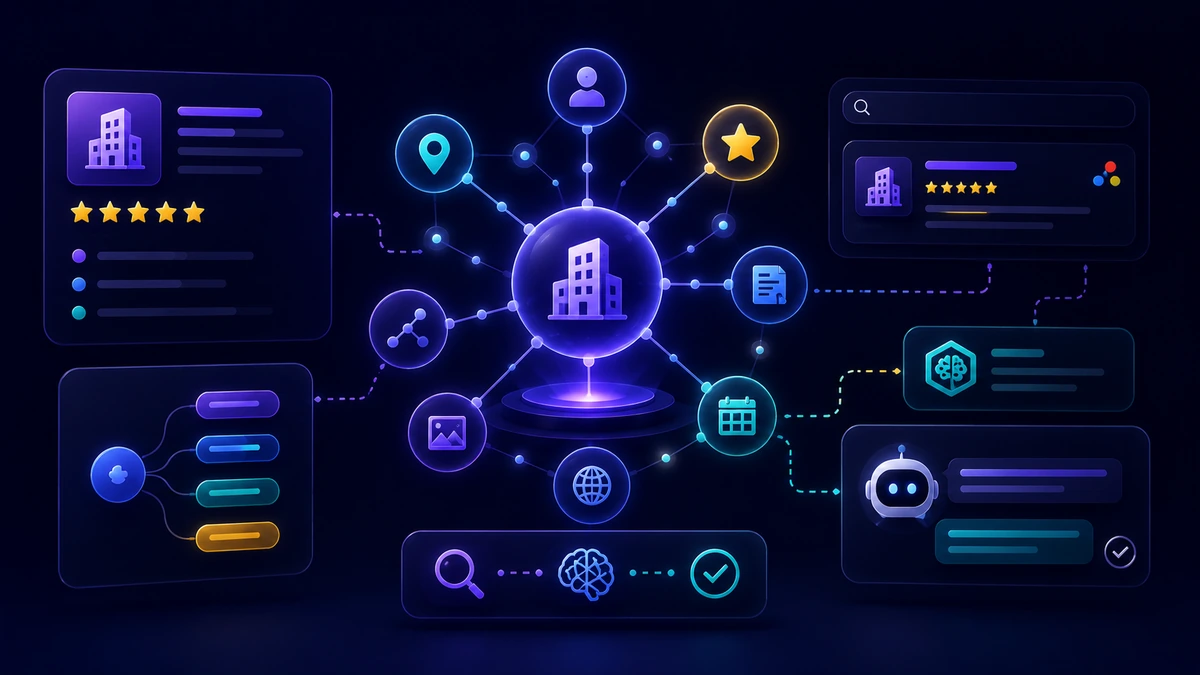
Google's structured system. The goal: for Google to understand WHO you are as an entity (person, company, place). Once you exist in the Knowledge Graph, you get a Knowledge Panel (the panel to the right of Google results).
- Be present on 20-30 sites that Google trusts and uses to build Knowledge Graphs.
- «Points of contact» on high-authority sources (Wikipedia, Wikidata, Crunchbase, etc.)
- In 2025-2026, the horizontal Knowledge Panel Cards for businesses are new and easier to trigger.
- Google now uses Gemini to generate multi-source descriptions for Knowledge Panels.
- Kalicube estimates that Google uses over 200,000 trusted sources to power its panels.
- People with a Knowledge Panel quadrupled between June 2023 and June 2024
- The number of C-level executives with a panel is exploding, especially in YMYL companies.
System 2: Recommendations & Mentions
When Google or an AI doesn't have a perfect and very reliable source on a topic, it explores the web and finds mentions, recommendations, and listicles. This is disconnected from the Knowledge Panel but carries a lot of weight in Local SEO.
- Mentions in articles «Top 10 Best...», «Best Tool for...»
- Reddit recommendation Threads (Reddit = source #1 for LLMs, 40.1%)
- Comparisons, tests, reviews from third-party sites
- Forums specialize in discussions on platforms like Quora and Stack Overflow.
- LLMs love «listicles»: content structured with lists of recommendations
- To be mentioned in podcasts, interviews, and press articles that are indexable
- Reddit content is used in Google and OpenAI training (60M deal$)
Top sources for Knowledge Graph
The sites Google relies on to build and power Knowledge Panels. The goal: to be present on as many of these platforms as possible with consistent information.
What we deploy concretely
The tools, providers, and methods we use in our agency to build our clients' web authority. Accessible solutions that are available on the market.
Bulk Social Profiles
Creation of 100+ coherent social profiles on major platforms. This is one of the most accessible and cost-effective levers for starting to build your brand.
- The more coherent and interconnected social profiles you have, the more Google detects and understands your entity.
- Social profiles are displayed directly in Knowledge Panels (links to X, LinkedIn, YouTube, etc.)
- There's no need to feed them all manually. The mere fact that they exist, are coherent, and are connected already plays a very important role in structuring the entity.
- If possible, automate with AI to create a minimum of activity on each platform
- Crucial coherence: same name, same description, same logo, same information everywhere
- Horizontal Knowledge Panel Cards in 2025-2026 will make social profiles even more visible
Wikidata item
Wikidata is the structured database that Google uses DIRECTLY to power the Knowledge Graph. It's literally the language Google understands best.
- Wikidata = the «technical sheet» of your entity in structured data
- Google directly pulls information from Wikidata to build Knowledge Panels.
- Each Wikidata entity is linked to other entities (relationships, categories, properties).
- Check if you already have an entry: go to wikidata.org and search for your name or brand
- This is the «machine» version of Wikipedia: if Wikipedia is for humans, Wikidata is for algorithms.
- A well-filled Wikidata item significantly speeds up the appearance of a Knowledge Panel
Pack Wiki Links
A set of links on mini-wikis and databases that Google recognizes as reliable sources for validating the existence of an entity.
- Includes: CrunchBase, WikiAlpha, Fandom, and other mini-wikis recognized by Google
- These sources validate the existence of the entity and strengthen the «web of trust» around your brand.
- Each link is an additional «vote of confidence» in the Google ecosystem.
- These mini-wikis are often among the 200,000+ sources Google uses for its Knowledge Panels.
- The more consistent presences you have on these platforms, the stronger your entity becomes.
Enterprise Knowledge Panel
The creation of the famous Google sign for your business. It is the most visible and impactful element of the entire strategy.
- The Knowledge Panel in 2026 is much more than a box: horizontal cards, attributes, key people, reviews, trust score
- Google uses Gemini to combine multi-source descriptions (not just Wikipedia).
- Do NOT launch a personal Knowledge Panel + business at the same time. It can create confusion for Google.
- If the person already has a personal KG, prioritize the company KG.
- Key People (leaders with their own KPs) are now displayed in the corporate panel
- The change in «cohort» in the Knowledge Graph can take a year or more
- A Knowledge Panel is a strategic asset: few competitors have structured it properly
Google Business Profile (GMB)
One of the most accessible ways to enter the Knowledge Graph properly and easily. Anyone can do it, even without prior fame.
- GBP directly powers the Knowledge Panel and local results (Maps, etc.)
- Validation can take time: sometimes 10+ days, with a possible video step
- For the validation video: show the address clearly visible, the premises, an office
- It's free and accessible to all businesses
- A well-optimized GBP creates synergies with the rest of the strategy
- We are exploring methods to accelerate and multiply the effects of GBP
- The GBP is NOT a Knowledge Panel (it's a business profile that YOU create), but it contributes strongly to it
- Photos, reviews, posts, and Q&As on GBP enrich the entity.

Capture customers searching near you
Master "[service] + [city]". Calls, visits, real clients.
The distinction important
Not all directories are created equal. There's a fundamental difference between classic SEO directories (backlinks) and directories that feed the Knowledge Graph and entities.
Classic SEO Directories
Relevant for backlinking, domain authority, and SEO juice. Always useful, but they do NOT work on the Knowledge Graph and Named Entity parts.
High-value entity directories
Platforms with verification systems, an official and verified side. Google and AIs love these sources because they are reliable.
Wikipedia the keystone
Wikipedia is a subject in itself, it's so powerful. It's the most used source by AIs and the one with the most impact on the Knowledge Graph.
(47.9% of top quotes)
from GPT-3 come from Wikipedia
have a Wikipedia page (Trackerly.ai)
-
🎯
Location: Wikipedia is heavily used by ChatGPT and all LLMs. ChatGPT became the number #1 source of traffic to Wikipedia in June 2025 (Similarweb). AIs consult and cite Wikipedia in real-time via RAG.
-
The Parthenon
Entity : Having a Wikipedia page = a much stronger Knowledge Panel. Sites with a strong Knowledge Panel (including Wikipedia) tend to rank better overall. It's a signal of notoriety, legitimacy, and reliability.
-
💎
Domains Expired: Buying back an expired domain that has a Knowledge Panel is extremely powerful. The Knowledge Panel often «survives» the change of ownership, and that's a huge competitive advantage.
-
Warning
Reality: Creating a Wikipedia page is difficult. It requires notability, independent secondary sources, and adherence to strict editorial rules. We work a lot on this in agencies with expert providers. We improve existing pages, deploy new ones, populate them, and ensure everything runs smoothly.
-
🚀
Our quest: We're fighting to create a Wikipedia page for the agency for personal branding, even without the «official» notoriety required. It's a long-term challenge but a huge strategic asset. In the meantime, Wikitia, Golden, and CrunchBase are good alternatives.
-
📝
Optimization If you already have a page, make sure it's well-optimized. The first sentences are what Google uses for the Knowledge Panel. Add quality sources, keep the information up-to-date, and make sure you are cited in other Wikipedia articles related to your field.
Generative Engine Optimization
Everything that works for the Knowledge Graph overlaps with what works in GEO. E-E-A-T (Experience, Expertise, Authoritativeness, Trustworthiness) signals are central to both. LLMs use RAG: they fetch sources in real-time, and these sources are exactly the ones we mentioned.
Multi-source descriptions via Gemini
Google uses Gemini to combine multiple descriptions from different sources. Wikipedia is losing weight, Google is increasingly drawing from companies' own websites.
- The importance of the 'entity home» on your site is exploding
- Optimize your descriptions on ALL platforms
- The first sentences count enormously
Essential Entity Home
Your site + schema markup = your source of truth for Google and AI. It's the central page that defines your entity.
- Schema markup: Organization, Person, LocalBusiness
- Consistent information across all your web presences
- Page «About» detailed with history, team, mission
- Links to all your official profiles
Google & Microsoft Patents
Patents reveal how AIs process entities: multi-page synthesis, hierarchical graphs, authority scoring.
- Google treats an entire website as a single LLM input
- AI generates a synthesized «characterization» of the entity
- Hierarchical structure in a parent/child graph
KP Cards 2025-2026
Horizontal Knowledge Panel Cards for businesses are new and increasingly easier to trigger.
- Top rail horizontal cards = new for businesses
- Right rail vertical cards = new in 2025
- Filter pills to navigate sub-entities
- Key People (C-level with their own KP)
The GEO is a team sport.
SEO + content marketing + PR + social media. Signals must come from everywhere to maximize AI visibility.
- Digital PR = external validation that LLMs love
- LLMs favor recent and updated content
- Sources with license agreements (e.g., Reddit/Google) are preferred
Wikipedia page GEO
The GEO now has its own Wikipedia page. The subject has become mainstream and essential.
- RAG = Retrieval-Augmented Generation
- LLMs cite 2-7 domains per response
- Citation authority replaces backlinks
- Visibility score > organic ranking

Be quoted by ChatGPT, Perplexity, and Gemini
60%: Some searches don't require a click. You are selected by AI.
Two systems in parallel,
a major competitive advantage
The Knowledge Graph is a long-term strategic asset. Very few competitors structure it correctly, and even fewer combine it with a GEO strategy.
Strategic asset
long term
Mentions, listicles,
Reddit, forums
Prepare for the future
generative AI
The grail of authority
for AI