


A high-performing SEO blog in 2026 relies on three pillars: one Information-dense content strategy, regular maintenance (updates every 8 months minimum) and optimization for search engines AND generative AI (GEO). Companies that publish 9+ articles per month see their traffic increase by 35,8 % in one year. Long articles (+3,000 words) generate 3x more traffic. This guide covers creating, optimizing, and maintaining an SEO blog that generates qualified traffic and leads.
A business blog without SEO strategy is like a billboard in the desert. You publish, nobody reads. In 2026, 91 % of web pages receive no organic traffic from Google. The main reasons: no backlinks, no keyword strategy, and no maintenance of existing content.
However, the numbers are clear: companies that invest in a structured SEO blog generate 13x more leads those who don’t have it (HubSpot). Content marketing costs 62 % cheaper than traditional marketing while generating 3 times more leads.
The problem isn't the blog itself. It's the way it's designed, written, and maintained. This guide details everything: from keyword research to the inverted pyramid writing, including content maintenance and optimization for generative AI.
How to build an SEO content strategy for your blog?
Content strategy is the foundation. Without it, you're publishing randomly and hoping Google notices you. Spoiler: it won't.
Keyword research: targeting the right queries
effective blog post starts with a validated main keyword. Here is the method:
- Identify your persona's requests What questions do your clients ask themselves before buying? What terms do they use on Google?
- Use SEO tools Ahrefs, Semrush, Google Keyword Planner, or Recommended SEO tools to validate search volume and difficulty.
- Analyze search intent Each query has an intent (informational, transactional, comparison). The format of your article should match this intent.
- Do not ignore the keywords «zero volume» ultra-specific queries that tools don't detect but that meet the precise needs of your personas often convert better than high-volume keywords.
Cover all search intents
A good SEO blog doesn't just target keywords. It comprehensively answers all search intents around a topic: main intentions, micro-intentions, and even «zero-volume» queries.
For each article, identify:
- The main intention : the central question the article answers.
- Micro-intentions : the sub-questions that the reader naturally asks themselves while reading (the People Also Ask section is a good indicator).
- side queries : associated terms that demonstrate comprehensive expertise on the subject.
Semantic optimization: going beyond the keyword
In 2026, keyword stuffing is counterproductive. Google understands the semantics and evaluates if your content covers the semantic field with a subject.
The use of tools like ThotSEO, Surfer SEO, or Clearscope allows you to check if the lexical field is sufficient to demonstrate real expertise in the eyes of the algorithm. The objective: to achieve a semantic score greater than 60 % while keeping a natural writing style.
Plan a realistic editorial calendar
The data is clear on the publication frequency:
| Publishing frequency | Annual traffic growth | Impact leads |
|---|---|---|
| 1-4 articles per month | +16,5 % | Slow growth |
| 5-8 articles per month | +25 % (estimated) | Steady growth |
| 9+ articles per month | +35,8 % | 13x more leads |
The important thing is not to publish a lot, but to publish. consistently with a constant level of quality. 4 high-quality articles per month are better than 12 generic articles. Quality is measured by Information density Each sentence must contain a verifiable fact, a statistic, or a methodology.
How to write an SEO-optimized blog post that performs well
The inverted pyramid: critical information first
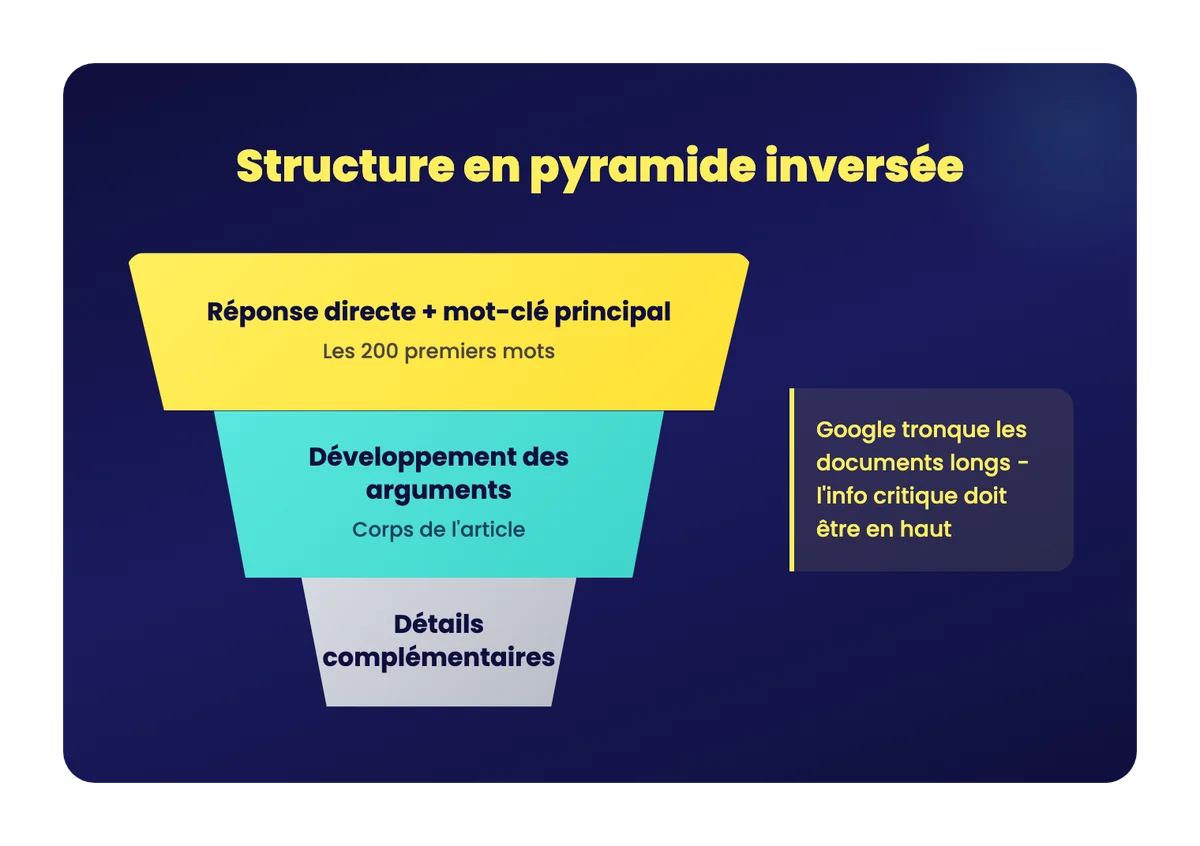
This is rule #1 of web copywriting: place the most important information from the beginning of the article. Why? Google tends to truncate long documents during its analysis. If your answer to the search intent is buried in paragraph 15, Google might never see it – and neither will your reader.
Concretely:
- The first 200 words must contain the main keyword and directly answer the question asked.
- The TL;DR (summary at the beginning of the article) gives the answer immediately. The rest of the article develops and elaborates.
- Each section Start with the conclusion, then develop the arguments.
The «protein vs. fat» ratio: information density
The quality of an SEO blog post is measured by its Information density. The «protein to fat» ratio concept is simple:
- Protein = verifiable information, figure, fact, methodology, concrete example.
- Bold = empty phrases, filler, empty transitions, generalities.
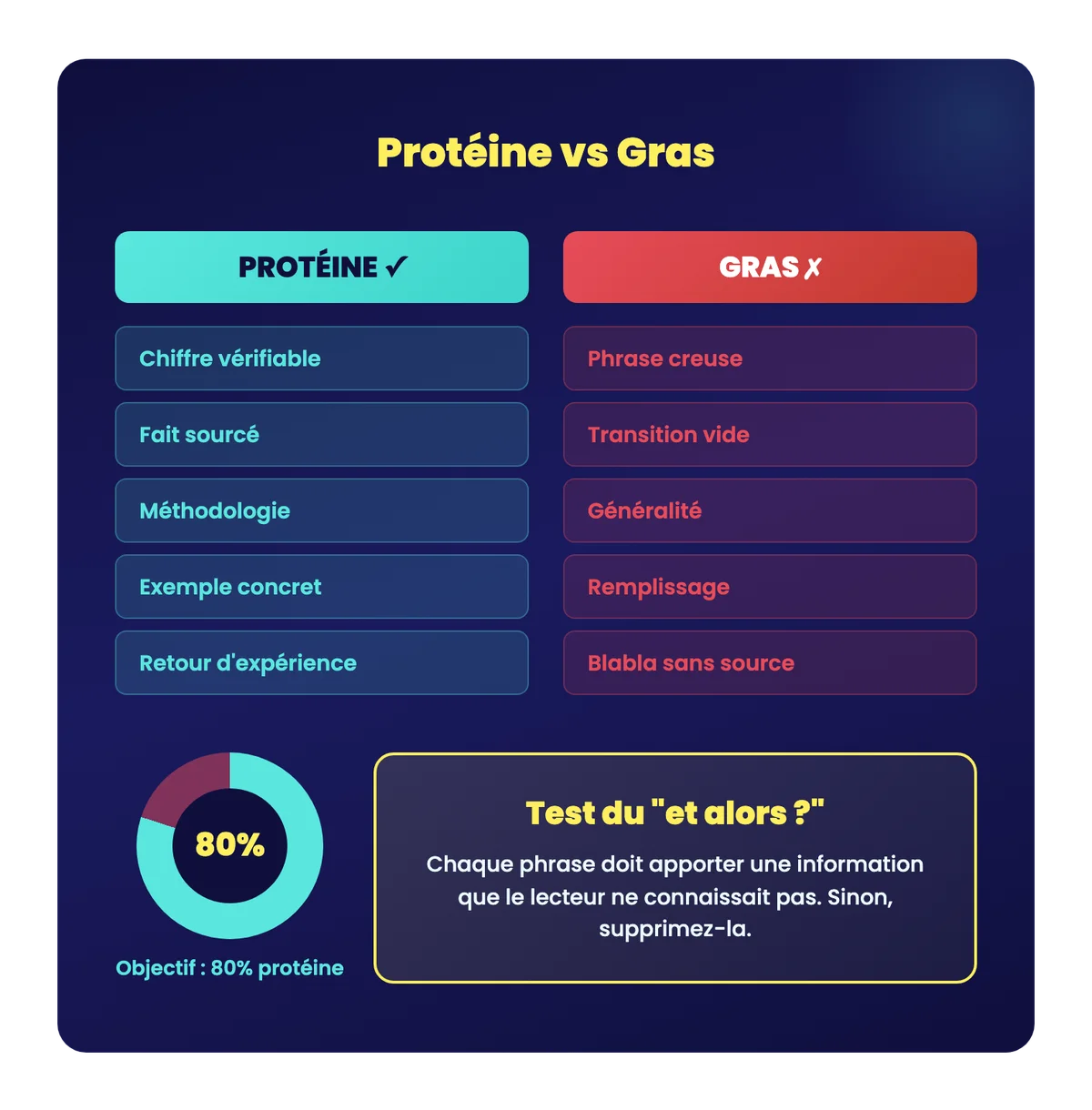
The objective: 80 % of protein. Every sentence must pass the «So what?» test. If a sentence offers nothing new to the reader, it should be enhanced with a number or fact, or deleted.
Cutting out the superfluous doesn't mean being brief. A 5,000-word article can be 100 % protein if each paragraph brings value. And an 800-word article can be 100 % acres if he says nothing concrete. Length isn't the problem – density is.
Differentiate from AI-generated content
In 2026, the web is flooded with standardized AI content. To rise above this mass of «average» content, a blog must:
- Bring exclusive new information Proprietary data, field experience, internal case studies, real A/B tests.
- Adopt an original tone Content that has a real editorial «stamp» keeps the reader engaged and encourages sharing. A direct tone, strong opinions, and controlled humor.
- Multiply concrete examples No abstract theory, real cases with names, numbers, and results.
- Integrate unique visual elements Infographics, screenshots, diagrams that cannot be generated by a basic AI prompt.
The optimal HTML structure of a blog post
A well-structured article facilitates reading AND indexing by Google:
- H1 : the title of the article, ideally in the form of a question containing the main keyword. Managed by WordPress, not in the HTML content.
- H2 : the main thematic sections. Descriptive and explicit, never vague («How to optimize?» instead of «Optimization»).
- H3 : the subsections detailing each H2.
- Short paragraphs 3-4 lines maximum on mobile for easier reading.
- Strategic grasp : always on meaningful word groups, never on isolated words. Test: by reading only the bold text, one understands the essential of the article.
- Lists : to structure steps, criteria, or examples.
- Tables for comparisons and figures (with horizontal scroll for mobile).
Title tag and meta description: the keys to CTR
The title tag is the first element a user sees in the SERP. In 2026, the Google Leak Data Confirm that the correlation between the presence of the exact keyword at the beginning of the title and a good ranking is 0.75.
Best practices:
- Title Tag Keyword first, max 60 characters, differentiating element (year, number, «complete guide»). Titles containing «Guide» generate 3x more organic traffic.
- Meta description Write concise meta descriptions (120-155 characters) that directly address search intent and implicitly encourage clicks, improving CTR without affecting rankings.

Content that generates leads, not just traffic
High business impact keywords, articles that rank and convert.
Blog Maintenance: Why and How to Update Your Articles
A blog post is not a static asset. It loses its position over time if the competition is inspired by it to do better. Regular maintenance is the difference between a blog that grows and a blog that stagnates.
The optimal update frequency
Every important page must be reviewed at least once a year to check if the search intent has changed and to update the semantics. On average, an update cycle of 8 months It is recommended.
For ultra-competitive niches (casino, finance, tech), the frequency can drop to Every two weeks to maintain the freshness signal.
The impact is measurable: publishing old articles with updated content can increase your site's traffic by up to 111 %.
What to update in an existing article?
- Outdated data outdated figures, statistics, or studies (we are in 2026, a figure from 2022 is obsolete).
- Semantics The search intent may evolve. Check that the current SERP still matches your article's format.
- The internal mesh Add links to your new articles published since the last update.
- Visual elements Add images, interactive widgets (quizzes, polls) that enhance engagement.
- The title tag and the meta description Update the date and numbers to improve perceived freshness.
Google's algorithm incorporates a freshness criterion.Query Deserves Freshness. Use tools like Serpenti or ContentKing allows you to monitor the recommended lifespan of content before its next update.
Content pruning: trimming dead content
Not all items are worth keeping. The content pruning (Content pruning) consists of identifying and processing pages that drag down the overall performance of the blog:
- Pages with 0 traffic for 6+ months Merge with a similar article or delete.
- Duplicate content pages Merge or canonicalize. See our guide on the duplicate content.
- Pages with thin content (< 300 words without added value): enrich or delete.
Link building and authority: how to make your blog credible
High-quality content without backlinks will not rank. 91 % des pages sans trafic organique n’ont aucun backlink. Link building is the fuel that propels your blog into the top 3.
The diversity of connections: the key to a healthy profile
A natural link profile should mix different types of backlinks:
- Guest posts (guest blogging): you publish an article on a third-party website with a backlink to your blog.
- Ninja Linking Inserting links in relevant forums, social profiles, and comments.
- High-value entity directories Directories recognized by Google as reliable sources.
- Natural editorial links : when other sites cite your content spontaneously (the Holy Grail of link building).
For a structured netlinking strategy, quality is what matters: a backlink from a page that generates organic traffic and is located in a’Primary Index (Golden Index) 10 links from sites without traffic are worth Google.
E-E-A-T and author validation
To be recognized as a reliable source by Google and AIs (ChatGPT, Perplexity), the blog must:
- Validate your authors via Knowledge Panels: optimized LinkedIn profiles, citations in reference media, detailed author pages.
- Demonstrate expertise Mastery of technical vocabulary, detailed methodologies, field experience.
- Prove the experience Real-life examples, customer case studies, proprietary data.
- Inspire confidence Transparency in methodologies, no exaggerated promises, sources cited.

Boost your authority with premium backlinks
Targeted strategy, optimized anchors, measurable ROI.
Blog SEO and AI: The Emergence of GEO (Generative Engine Optimization)
The arrival of AI Overviews and SearchGPT is a game-changer for informational blogs. An SEO blog in 2026 can no longer ignore the AI search engines.
The impact of AI on informational blogs
The numbers are concerning for purely informational content:
- How-to guides and purely informational articles are seeing their traffic drop from -40 % when an AI Overview is present.
- «Zero-click» searches represent 60 % requests in 2026.
- Gartner predicts that 25 % of organic traffic will migrate to AI chatbots by the end of 2026.
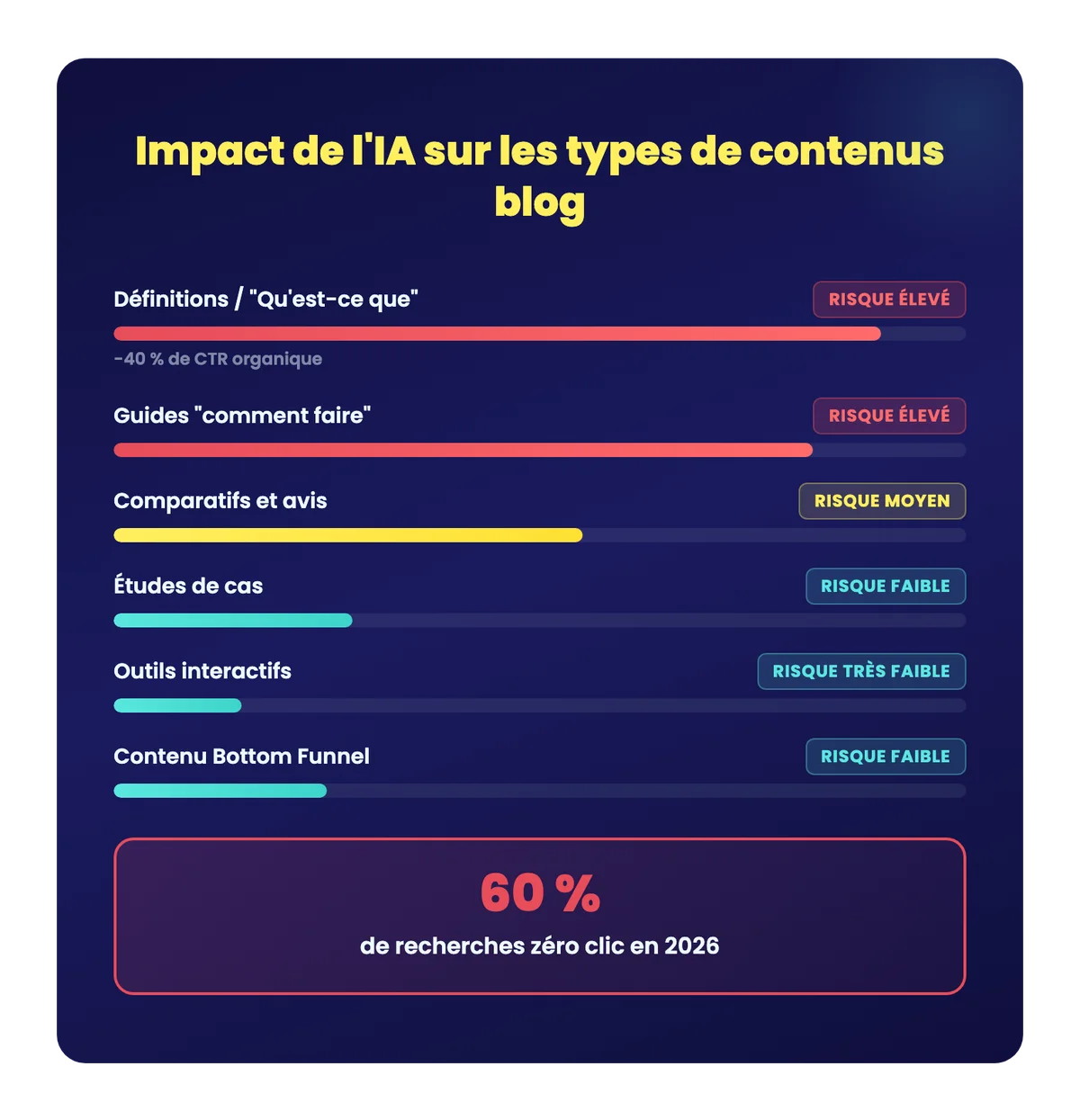
The classic informational blog («definition of X,» «what is Y») is the most threatened because AI can answer directly without redirecting to a site.
Becoming a Source for LLMs: The New Holy Grail
Blogs serve as Knowledge base for ChatGPT, Perplexity, and SearchGPT. Ranking in the top 30 on Google potentially allows you to be cited as a source by these generative AIs, which is becoming a major lever of influence.
To optimize your blog for GEOGenerative Engine Optimization) :
- Structure with FAQs, clear definitions, and data figures that AIs can easily extract and cite.
- Strengthen presence on Wikipedia and Wikidata LLMs extensively use these sources to validate entities.
- Publish proprietary exclusive data AI cites sources that provide new information, not those that rephrase what already exists.
- Optimize structured markup JSON-LD for FAQs, HowTo, Article. AIs use this structured data to understand content.
Adapting blog strategy in the face of AI
The answer isn't to stop blogging but to’Adapt content type :
| Content Type | AI Risk | Recommended strategy |
|---|---|---|
| Definitions / «What is» | High (-40 % CTR) | Enrich with exclusive data, unique angle |
| How-to guides« | Raised | Add video, visual examples, real-world cases |
| Comparisons and reviews | Middle | Real-world tests, proprietary data, transparency |
| Case studies | Weak | Exclusive Data = Not Replicable by AI |
| Tools and Calculators | Very weak | Interactive value, impossible to summarize by AI |
| Bottom Funnel Content | Weak | Transactional intent = mandatory click |

Be quoted by ChatGPT, Perplexity, and Gemini
60%: Some searches don't require a click. You are selected by AI.
User Signals: Why Google Monitors Behavior on Your Blog
Modern SEO is moving closer to conversion marketing. Google uses Chrome (NavBoost) data to judge the quality of a blog.
Engagement metrics that matter
- Time spent on page : a direct sign of quality. An article read for an average of 4+ minutes is a good sign.
- The scroll rate Google measures how far users scroll. An article read to 80 %is rated better than an article abandoned at 20 %.
- Internal linking (link clicks) Users who click on other articles on your blog send a strong positive signal. That is why internal linking is crucial.
- Pogosticking When a user clicks on your result, returns to the SERP, and clicks on a competitor, it's a negative signal. Your content did not meet their needs.
Branding: The ultimate protection for your blog
The more your brand is searched for directly («Brand Search»), the more Google grants you legitimacy. This brand signal protect the blog during algorithmic updates (Core Updates).
Blogs that have survived the recent Core Updates have one thing in common: a strong brand with regular branded research. It's a virtuous cycle: quality content builds the brand, and the brand protects the content.
Turn blog traffic into leads and revenue
A blog that generates traffic without converting is a blog that costs money without making any. Here’s how to structure conversion.
Lead magnets: capturing visitor emails
On content Top of tunnel (informational), the goal is to capture the email address via:
- Free email training (5-day sequence): The most effective format in B2B.
- Specialized Newsletter Weekly exclusive content.
- Ebook or PDF guide enhanced version of the article with exclusive bonuses.
- Webinar or replay for complex subjects that lend themselves to demonstration.
The lead captured is then nurtured via automated nurturing scenarios to bring them towards bottom-funnel content and conversion.
Optimize CTAs in blog posts
Optimizing calls to action (CTA) is critical. Google gives increasing weight to behavioral signals, and a site that converts well is a site that Google appreciates:
- Maximum 2 CTAs per article One inline in the body, one at the end of the page.
- Contextual CTAs adapted to the subject of the article, not a generic CTA that's the same everywhere.
- Strategic positioning : the inline CTA after the section that brings the most value (when the reader is convinced of your expertise).
The best SEO blogs to follow in 2026
To stay up-to-date on SEO developments, here are the Reference French and English SEO blogs :
French-language SEO blogs
- Abundance (Olivier Andrieu): the historical reference for French-speaking SEO since 1998. Google news, Core Updates analyses, fundamental guides.
- Miss SEO Girl web writing and content strategy oriented content, with an accessible tone.
- SEMJuice : Specialized in netlinking and link strategy.
- Eskimoz Blog : Complete SEO guides and case studies.
- Google Search Central (official documentation in French): the guidelines directly from Google.
English-speaking SEO blogs
- Ahrefs Blog Big data studies, detailed technical guides.
- Search Engine Land SEO news and Google update analyses.
- Backlinko (Brian Dean): CTR studies, link building techniques, actionable guides.
- Moz Blog SEO Fundamentals, Whiteboard Friday (explainer videos).
Technical checklist for a high-performing SEO blog
| Criteria | Standard 2026 | Why is it important |
|---|---|---|
| Loading speed | < 2.5 seconds (LCP) | Each additional second = -7 % conversions |
| Mobile-first | 100 % responsive | 60 %+ traffic is mobile |
| Internal meshing | Each article has 3-5 internal links | +40 % organic traffic possible |
| Markup Schema | Article, FAQ, HowTo in JSON-LD | Rich snippets + source for LLMs |
| Sitemap XML | Automatically updated | Faster indexing of new articles |
| Canonical tags | On each page | Avoid duplicate content |
| Core Web Vitals | All in green | Confirmed ranking factor |
| Image alt text | Description with natural keyword | SEO Images + Accessibility |
| HTTPS | Mandatory | Ranking factor since 2014 |
| robots.txt | Allow blog crawling | No indexing = no traffic |
An SEO blog in 2026 is much more than a simple publishing tool. It's a acquisition system who combines content strategy, technical optimization, link building, continuous maintenance, and adaptation to generative AI. Companies that treat their blog as a strategic asset—investing in quality, updates, and authority—are the ones that capture majority of 53 % of web traffic which comes from organic search.
The blog is not dead. The mediocre blog is dead. The blog Information-dense, regularly updated, and backed by a strong brand has never been so powerful.