


Choosing your SEO keywords is above all analyze search intent and the SERP before touching any tool. Prioritise bottom-of-funnel queries (reviews, alternatives, VS) for quick ROI, make use of zero-volume keywords through persona targeting, and use Google Trends to anticipate trends 3 to 12 months ahead of your competitors. The result: qualified traffic who converts, not just visits that bounce.
You type "how to choose SEO keywords" into Google and land on 10 guides that all tell you the same thing: use Google Keyword Planner, look at search volume, target the long tail. The problem? 90 % of these guides have you start with the wrong step. They throw you into a tool before you even understand what your prospect is really typing into the search bar.
The result, we see it with almost every client who comes to the agency: pages optimized for keywords with 5,000 monthly searches generating zero leads. In fact, during this time, a competitor positioned on a query with 50 monthly searches signs contracts every week.
The reality is that The choice of keywords conditions 80 % of your SEO results. Not link building, not technical SEO, not content. The keyword. Because if you target the wrong keyword, all the rest of your SEO work is for nothing.
In this article, you will discover the 6-step method we use in our agency to choose keywords that bring in business. No copied theory, but a field-tested process from hundreds of projects.
Pourquoi 80 % des sites choisissent mal leurs mots clés (et perdent du trafic qualifié)
The Search Volume Trap: A 500 Search Keyword That Converts Beats a 10,000 Search That Bounces
The classic reflex when starting an SEO strategy is to open Semrush or Ubersuggest, type in your business, and sort by search volume in descending order. It seems logical. Except that The volume says nothing about the business potential of a query.
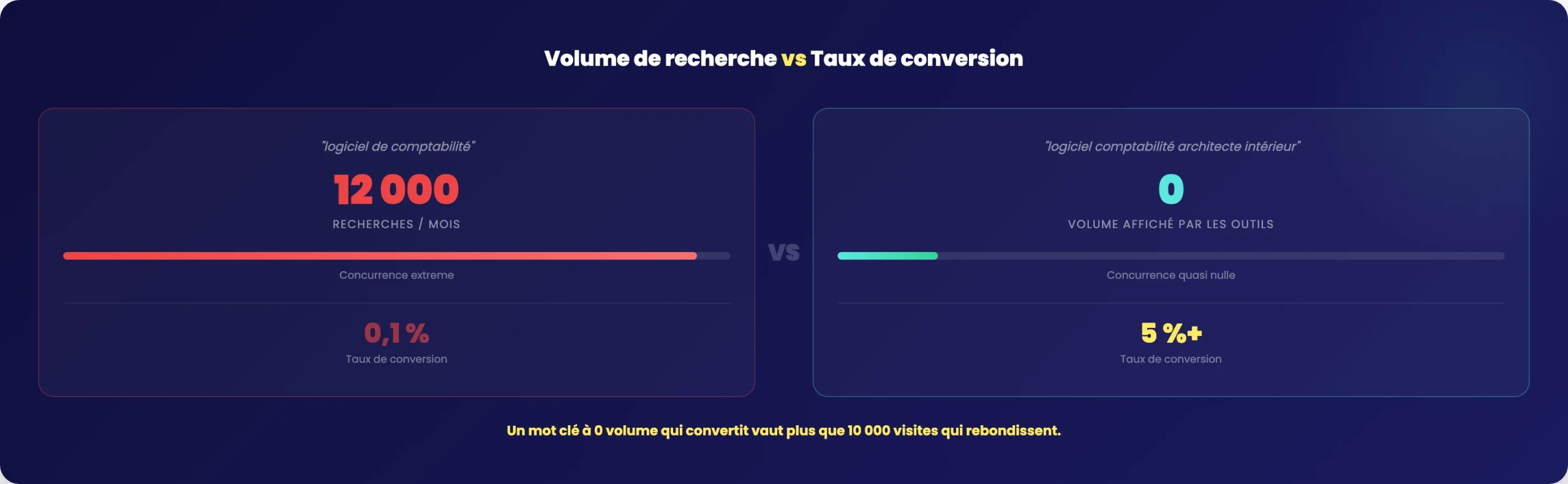
Let's take a concrete example. «Accounting software» shows 12,000 monthly searches. «Accounting software for interior designers» shows 0 in Ahrefs. Yet, the second expression corresponds to a user who knows exactly what they are looking for, has a specific need, and is ready to buy. The conversion rate for this type of long-tail query regularly exceeds 5 %, compared to 0.1 %for the generic term.
A relevant keyword is a keyword where The user's intent matches what you sell. The number of monthly searches is one indicator among others, never the primary decision-making criterion.
What Google truly expects behind every search query: search intent
Google no longer ranks pages based on keyword density in the text. The search engine analyzes search intent behind each request and displays the content format that best suits it.
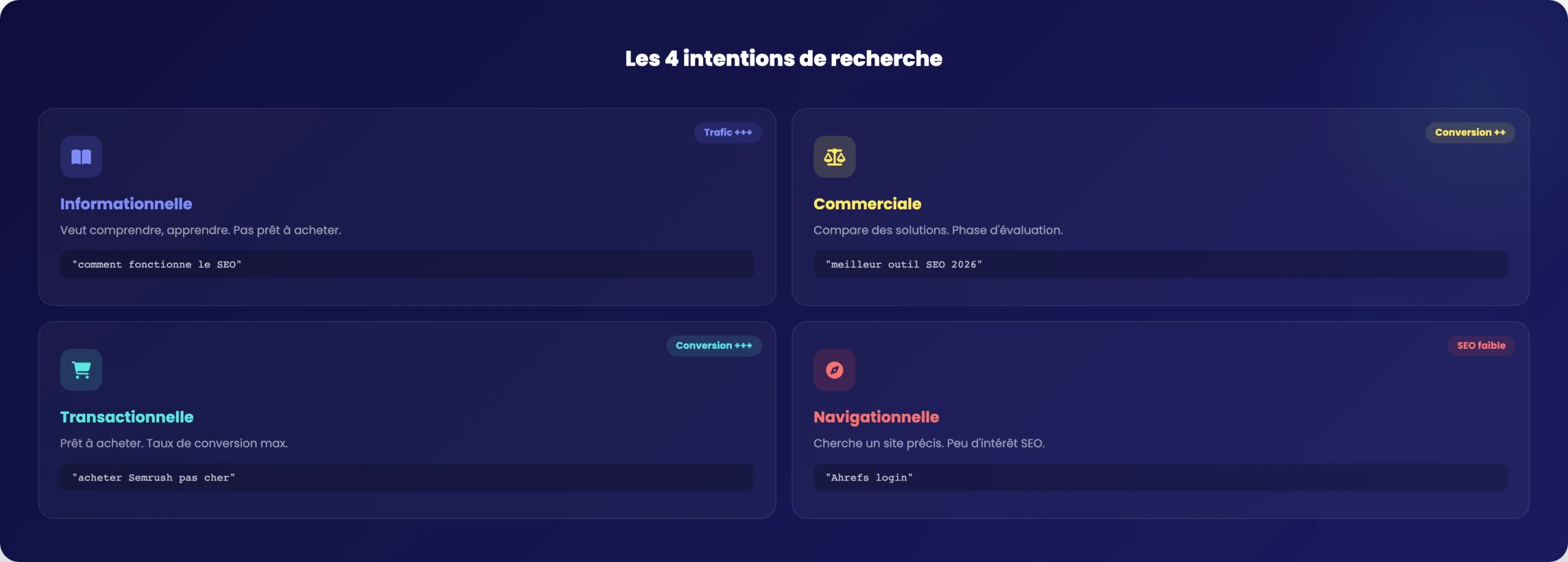
There are 4 main types of intentions:
- Informational how SEO works
- Commercial : he compares solutions («best SEO tool 2026»)
- Transactional «He is ready to buy (»buy Semrush cheap')"
- Navigational He's looking for a specific site («Ahrefs login»)
If you produce an informational guide on a transactional query, you'll never rank. Google knows it before you do. That's why SERP analysis must precede everything else in your keyword search.
Step 1: Go from the raw keyword to the question your prospect is asking
Formulate the precise question behind each query
The first step is not to open a tool. It's to ask yourself: What precise question is the internet user asking when they type this query?
Take the keyword "SEO keywords". Does the person want to know how to choose them? How to integrate them into their content? Which tools to use to find them? The raw query tells you nothing. The question behind it tells you everything.
In practice, structure your answer as if you were answering a client in person. If someone asks you "how do I choose my keywords", you don't start by listing 14 free tools. You first ask them What is its business objective?, What is its business sector, and what type of visitor does it want to attract?.
You can use AI tools such as Gemini or ChatGPT to identify the secondary questions related to your topic. But the starting point always remains the same: think like your prospect, not like an SEO specialist.

Identifying Sub-intentions: When Google Displays Mixed Results
Some search queries have mixed search intents. Type «SEO agency» into Google: you will find both sales pages, «Top 10 agencies» comparisons, and informative articles like «how to choose your agency».
When the SERP is mixed, it means that Google has not yet decided on the dominant intention. This is an opportunity: you can position yourself with a differentiating format that competitors haven't exploited.
To determine if two similar queries warrant one or two distinct pages, compare the search results. If Google displays the same URLs for «choosing keywords» and «finding SEO keywords,» a single page is sufficient. If the results differ, create a dedicated page by intention.
Step 2: Analyze the SERP before touching any tools
Decipher the top 10 results: format, content, competition level
Before going into Semrush or Ahrefs, open Google and type your target query. This is the most reliable data you can get, and it's free.
What you need to identify in 5 minutes:
- The dominant format Are the first results listicles («10 Tools For...»), long guides, comparison tables, or videos?
- The type of site blogs, SaaS tools, agencies, media outlets? That gives you the real level of competition.
- Content depth Number of words, presence of tables, images, numerical data
- The gaps What is no one covering? What angles are missing?
If everyone offers a listicle-type ranking, you have to do one too. But you can differentiate yourself by data quality, concrete cases and the practitioner's angle. This is where the added value lies.

One page or several? How SERP similarity helps you decide
When you have a list of close keywords, the question that always comes up is: should I make one big page or several separate pages?
The answer is in the SERP. Compare the results for each query. If 7 out of 10 URLs are identical Between two searches, Google considers it to be the same topic. A single well-optimized page is enough. If the results differ significantly, each search deserves its own page.
This analysis helps you avoid two classic mistakes: cannibalisation (two pages of your site competing for the same keyword) and dilution (a page that is too broad and does not precisely satisfy any intent).
Step 3: Prioritize according to the conversion funnel (ROI first, branding second)
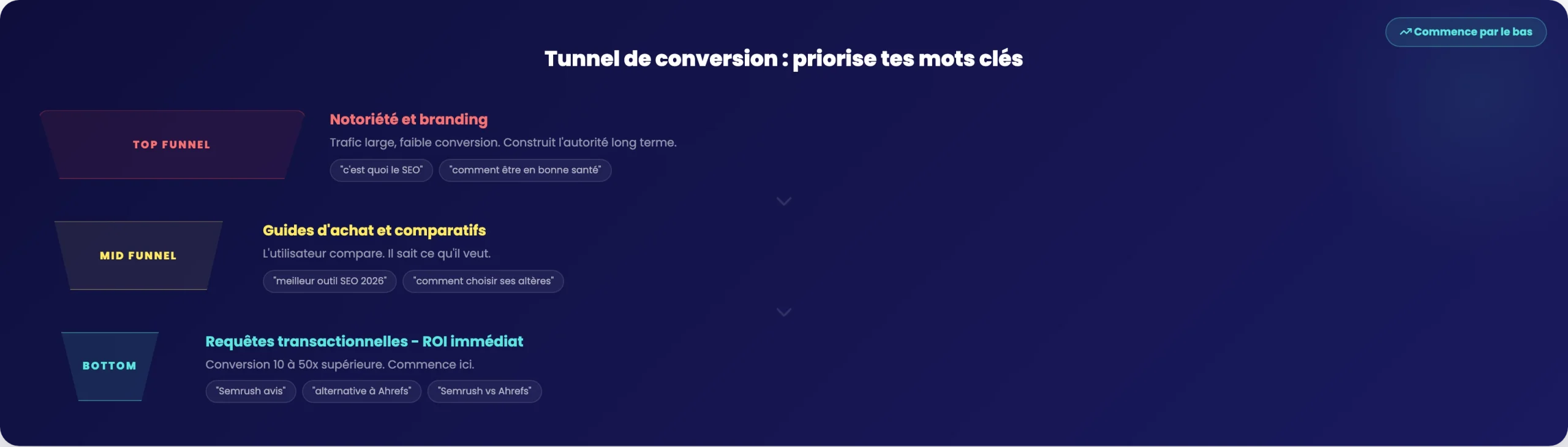
Bottom funnel first: «reviews,» «alternative,» «vs,» and transactional keywords
If you want generate revenue quickly, Start with low-funnel keywords. These are queries where the user is already in the decision-making phase:
| Type of request | Example | Why is that converting |
|---|---|---|
| «Reviews» | Semrush Review 2026 | The prospect is hesitant; they are looking for confirmation before buying. |
| «Alternative» queries» | Alternative to Ahrefs | He knows the market but wants to compare – position yourself as an option. |
| «VS» Queries» | Semrush vs. Ahrefs | Comparison = trusted third party, you capture both audiences |
| Transactional queries | Buy quality backlinks | Explicit purchase intention, the visitor is ready to take action |
These queries often have lower search volumes than generic terms. But the qualified traffic they generate is worth 10 to 50 times more In terms of conversion. It's the best starting point for building a profitable SEO strategy.
Mid-to-top funnel: buying guides and informational content for building authority
Once your bottom-funnel pages are performing and bringing in business, you can move up the funnel. Buying guides («how to choose dumbbells») and broad informational content («how to improve your Google visibility») are used to Build your thematic authority.
The advantage of this two-step approach: you finance your branding content with the ROI generated from the bottom of the funnel. You don't write 50 informational articles hoping that traffic will eventually convert «someday.» You build a Profitable content strategy from month one.
Be mindful of the semantic weight of your competitors: if the leaders for a query have already published 1,000 pieces of content on a topic and you only have 5, it's more effective to target intermediate, less competitive queries. The large number of pages indexed by a competitor on a subject creates an authority that you won't match with a single article.
Step 4: Leverage zero-volume keywords and trends
Persona-based targeting: combining your service with a hyper-precise target
SEO tools like Semrush, Ahrefs, or Ubersuggest show «0 volume» for thousands of queries that actually generate real traffic. Don't ever abandon a keyword just because your tool says zero..
The technique is simple: combine your product or service with an ultra-precise target persona. «Accounting software for interior designers,» «SEO agency for osteopaths,» «CRM for sports coaches.» These phrases correspond to searches that people actually type into search engines, but which the tools' databases haven't yet detected.
The reasoning behind: if the intention exists for a global profession (accounting software), it necessarily exists for its finer variations. And on these queries, Competition is almost nonexistent. You can position yourself on the first page with targeted content without needing backlinks or a high-authority domain.
Don't trust the volumes displayed by SEO tools for very specific queries. If the intent exists and your page perfectly matches it, the traffic will come. The best keywords are often the ones your competitors overlook because Semrush displays «0».
Google Trends for Anticipation: Classic SEO Tools are 3 to 12 Months Behind
Here's a point that almost no guide mentions: Search volume data in SEO tools is between 3 and 12 months old. on the reality of the market. When Semrush shows you a volume, it's a historical average, not a reflection of what's happening now.
Google Trends, on the other hand, gives you real-time developments. You can identify rapidly growing queries before your competitors: new products, legislative changes in your industry, emerging brand names.
Specifically, doing weekly monitoring on Google Trends within your niche gives you a head start. When others discover the trend 6 months later via Semrush, you're already positioned on the first page with an indexed article and a crawl history. This is a competitive advantage that traditional keyword tool analysis cannot offer.

Get an SEO quote tailored to your site and goals
Each project is unique. Get your personalized action plan with performance forecasts within a week.
Step 5: Validate with the right tools and cover the semantic field
Google Keyword Planner, Semrush, Ahrefs, Ubersuggest: What Each Tool Does (and Doesn't Do)
Each keyword research tool has its strengths and limitations. Using the right one at the right time saves you time and money:
| Tool | Best use | Principal limit | Price |
|---|---|---|---|
| Google Keyword Planner | Gross volumes, keyword ideas, Google direct data | Wide forks without active paid campaign | Free |
| Semrush | Competitive analysis, rank tracking, semantic audit | Data sometimes overestimated on small volumes | From 130 $/month |
| Ahrefs | Backlink analysis, keyword difficulty, top competitor pages | Smallest database on the French-speaking market | From $99 $/month |
| Ubersuggest | Discover keywords quickly, simple interface | Less reliable data than Semrush/Ahrefs | Free (limited) / 29 $/month |
| Google Search Console | Keywords your site already ranks for | Data limited to first 1,000 requests | Free |
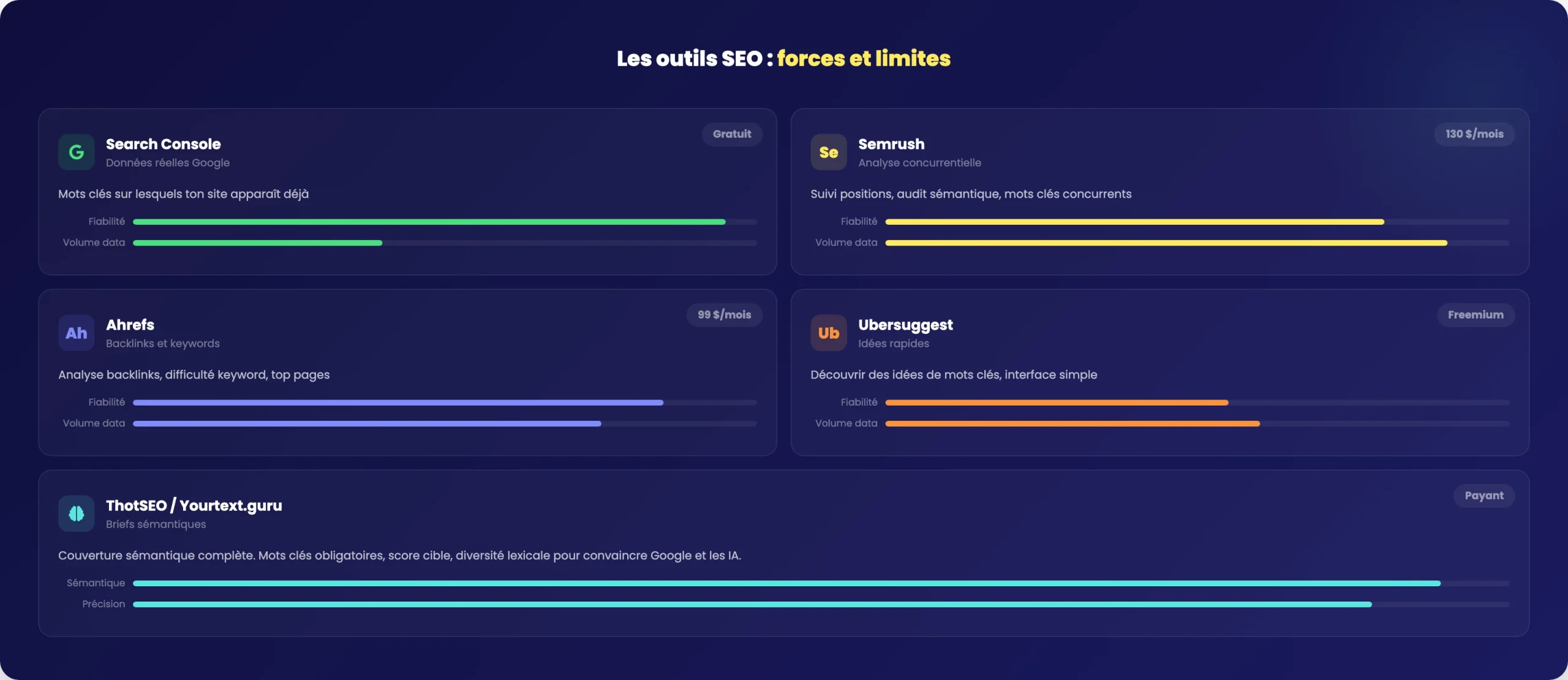
The best workflow: starts with Google Search Console to leverage queries where you already perform without knowing it. Some sites discover that they appear in positions 15-20 for high-potential keywords. Sometimes, simply optimizing the existing page can gain 10 positions and attract immediate qualified traffic.
Semantic Tools: Achieving Diversity That Convinces Google and AI
Once your main keyword is chosen, you need to cover the complete lexical field of the subject. This is what proves to search engines – and to AIs like ChatGPT or Google SGE – that your page covers the topic in depth.
Semantic briefing tools like ThotSEO, YourText.guru, or SerpMantis analyze the top-ranking pages and identify semantic occurrences that you need to incorporate. The goal is not to stuff your text with keywords, but to’achieve natural semantic diversity which corresponds to what Google associates with the subject.
In practice, a semantic brief gives you a list of mandatory keywords, a target score to achieve, and the recommended word count. It's the most commonly used work base for web writing professionals in 2026.
Google Search Console: Leverage the Keywords You're Already Ranking For
Google Search Console is the only free tool that shows you the real keywords people use to find your site. No estimates, real data from the search engine.
In the «Performance» report, filter by queries and sort by impressions. You will identify queries on which your website appears on page 2 or 3 of Google. These keywords are golden opportunities: you already have relevance in Google's eyes; all that's missing is better optimized content or a few internal links to go to the first page.
This technique is often more effective than creating content from scratch on a new keyword. You start with an existing base, which represents a considerable time saving. This is a valuable aid for companies that don't have the budget to produce 20 articles per month.
Step 6: Organize, integrate, and verify before writing
1 page = 1 main keyword + 1 intention: structure your content plan
The golden rule of any SEO content strategy: Each page on your site should target a single main keyword associated with a single search intent. Not two, not three. One.
Organize your keyword list in a table with these columns: keyword, search volume, difficulty, intent (informational/commercial/transactional), target URL, priority. This table becomes your editorial content plan. It allows you to visualize at a glance the pages to create, those to optimize, and those that are missing from your site.
Each line of this table corresponds to a web page to be produced or improved. This is the simplest and most effective way to manage its content creation without losing sight of the business objective behind each article.

Check for cannibalization with the site: command before launching a new page
Before you write a single word, check if you already have a page covering the same topic. SEO cannibalization is when two pages from your own domain are fighting for the same keyword in the search results. Instead of strengthening each other, they neutralize each other.
The simplest method: type site:tondomaine.com "keyword" in the Google search bar. You will immediately see which URLs from your site Google considers relevant for this expression. If a page already ranks, the best action is often to optimize it rather than create a new one.
Posting a new page on a keyword you already cover elsewhere on your site is The best way to lose positions on both pages. Always check with the command site: Before starting to write.
Where to place your keywords: title, Hn, URL, first paragraph, alt text
Once the main keyword is validated, its integration into the page follows a precise order of priority:
- Title tag (meta title) The main keyword at the beginning of the title, maximum 60 characters. This is the first signal Google reads
- H1 : restate the keyword as a question when relevant
- URL short, with the main keyword without filler words
- The first 200 words The main keyword and its variations should appear naturally in the introduction
- H2 and H3 integrates secondary keywords and related questions
- Image alt text Useful description with keywords when relevant, no filler.
The most frequent error: repeat the same keyword 50 times in the text. Keyword stuffing has been detected by Google for years. Use variations, synonyms, and long-tail expressions. Semantic diversity is more effective than repetition.

Content that generates leads, not just traffic
High business impact keywords, articles that rank and convert.
The 5 Mistakes That Ruin a Keyword Strategy
- Rely solely on search volume A high-volume keyword with zero conversion potential is worthless to your business. Always cross-reference volume, intent, and competition level.
- Ignore search intent Producing an informative article for a transactional query (or vice-versa) guarantees poor ranking. Analyze the SERP before writing.
- Neglect the long tail and zero-volume keywords As LLMs and conversational search grow, queries become longer and more contextualized. Not targeting them means leaving qualified traffic to your competitors.
- Forget to analyze the semantic weight of competitors If a competitor has 500 pages on your topic and you have 3, you need to be realistic about your chances of ranking for the most competitive keywords. Choose your battles.
- Do not monitor trends the tools display historical averages. Google Trends and industry monitoring give you real-time signals to get ahead

Cover the long tail at scale
Hundreds of pages optimized from your database.
Track and adjust your keywords over time
Metrics to monitor monthly in Search Console
Keyword selection is not a one-time job. Trends evolve, competitors publish, and Google updates its algorithms. Monthly monitoring in Google Search Console keeps you on track.
Key performance indicators to monitor:
- Average position A drop of 3 positions or more on a strategic keyword must trigger an action (content update, link addition).
- Click-through rate (CTR) : if you are in position 3 but your CTR is less than 5 %, your title and meta description are not attractive enough
- Impressions on new queries Are impressions appearing for keywords you hadn't targeted? That's a signal that Google associates your content with new themes – an opportunity to capitalize on.
- Pages losing speed Identify articles that are losing traffic month over month to optimize them before they fall out of the top 20.
When to change the target keyword on an existing page
Sometimes a page ranks better for a different keyword than the one initially targeted. This is a strong signal: Google says that your content better matches this other query.
If the impressions and traffic on the new keyword are higher than those on the original keyword, it is often more effective to pivot. Update the title tag, the H1, the URL if possible, and enrich the content to cover this new intent in depth.
Conversely, if your page has been stuck in positions 15-20 for over 6 months despite optimizations, it might be a sign that the keyword is too competitive for your current authority level. Redirect your efforts towards more accessible queries where you have a real chance of achieving results. As a last resort, consider that some SEO battles aren't worth the production cost: it's better to have a content offering targeted at 10 profitable keywords than 100 pages that bring in nothing.