


You publish articles on your blog regularly, but your web pages are stuck on the second or third page of Google. Your website covers many topics, yet no page truly stands out in search results. The problem is probably not the quality of your content: it's its Thematic organization.
Without structure, your pages cannibalize each other. Google doesn't know which page to rank for which query, and your internal linking distributes SEO juice randomly instead of concentrating it towards your target pages. Lots of web writing effort, little natural search engine optimization results.
This is the problem that the semantic cocoon. This concept, created by Laurent Bourrelly, proposes organizing your content into thematic groups connected by contextual internal links. Each page has a specific role in the site's architecture, each link has a logical direction, and the whole thing facilitates Google's indexing work while improving user experience.
Here's how to build an effective semantic cocoon: the complete definition, the SEO mechanisms that explain why it works, the 5-step method to create it, a detailed semantic cocoon example with its link structure, and the mistakes that sabotage most projects.

Content that generates leads, not just traffic
High business impact keywords, articles that rank and convert.
What is a semantic cocoon in SEO?
The concept of Laurent Bourrelly
The semantic cocoon is a SEO technique Theorized by the French SEO consultant Laurent Bourrelly starting in 2004. The definition of the "cocon sémantique" (semantic cocoon) can be summarized in one sentence: it is a method for structuring a website's content into groups of interconnected pages around the same topic, linked by a hierarchical internal linking structure.
What sets this approach apart from a simple categorization is its starting point: the user's search intent, not the site's internal logic. First, identify what the user is looking for at each stage of their journey (from discovery to purchase decision), then build a page structure that addresses all facets of that need.
The semantic cocoon is a strategy that borrows from content marketing and inbound marketing attract targeted traffic by answering the questions your buyer personas ask, then guide them towards conversion through logical navigation and relevant contextual links.
The 3 levels: parent page, child page, supplementary page
A semantic cocoon is organized around three hierarchical levels, often described by a genealogical analogy:
- The parent page (pillar page) This is the main page of the cocoon, the one you want to position for the most competitive main keyword. It presents the topic in a global and synthetic manner, and serves as a thematic entry point. Example: «Complete Guide to Natural Search Engine Optimization.».
- Child pages (intermediate pages) They cover the main sub-themes of the subject. Each child page deals with a specific angle in depth. This is where you target keywords with good search volume. Example: «Technical SEO», «Content Strategy», «Netlinking».
- Grandchild pages (supplementary pages) They respond to specific long-tail queries. These are often specific questions that the internet user asks. Example: «How to optimize a site's loading time,» «What is crawl budget.».
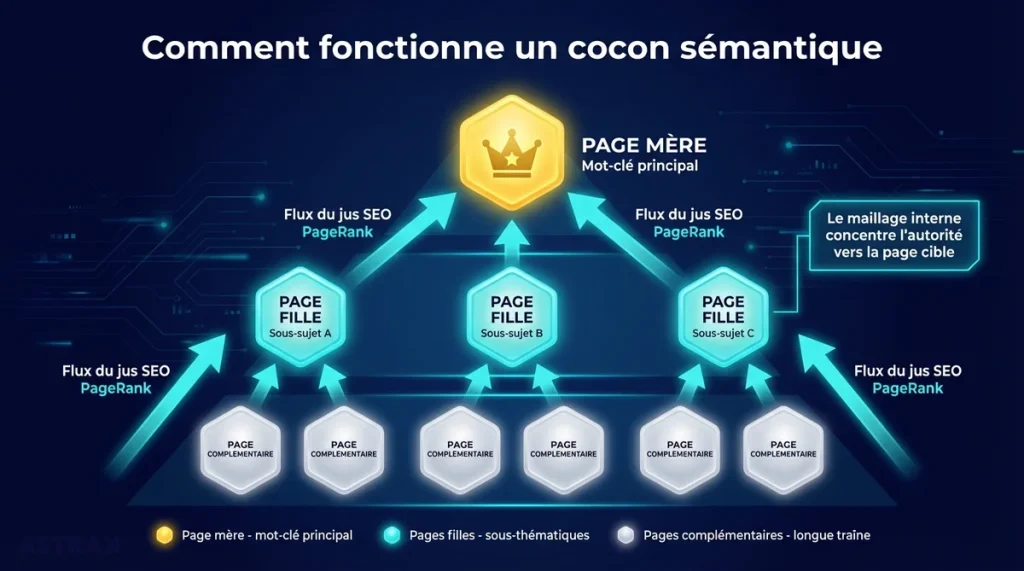
This tree structure creates a Inbound internal link flow. The supplementary pages send a link to their parent child page, and the child pages send a link to the parent page. SEO juice (PageRank) naturally flows up to the target page you want to rank on the first page of Google.
Lexical field, semantic proximity, and semantic shift
To build an effective semantic cocoon, you need to understand three key concepts from applied linguistics for SEO:
The lexical field design the entire set of words and expressions related to a theme. For the subject «rental investment,» the lexical field includes: profitability, rent, landlord, taxation, tax reduction, yield, LMNP (furnished non-professional landlord status), etc. Google uses the lexical field to evaluate relevance and semantic depth from one page. The more your content covers the complete lexical field of a topic, the more it is perceived as exhaustive.
Semantic proximity measures how closely two pages cover similar topics. Within a cocoon, related pages should have a strong semantic proximity. Linking a page about «how to calculate rental yield» to a page about «LMNP taxation» is logical: the two topics are semantically close. Linking that same page to an article about «how to choose a CRM» makes no sense.
Semantic drift is the gradual transition from one sub-topic to another within the same cocoon. It is the principle that guides the construction of branches: starting from the parent page (broad topic), you «slide» towards increasingly specific topics through child and grandchild pages. This slide must remain natural and logical for the internet user.
Between semantic cocoon and silo
The question often comes up: Semantic cocoon vs. silo, What's the difference? Both structure content into groups, but their logic is different:
| Criteria | Siloing strategy | semantic cocoon |
|---|---|---|
| Origin | Bruce Clay (USA) | Laurent Bourrelly (France) |
| Logic | Website organization by category | Organization by User Search Intent |
| Meshing Approach | Links strictly within the same silo | Contextual hierarchical links (child to parent) |
| Links between groups | Forbidden | Possibilities if semantic proximity justifies it |
| Starting point | Site structure | User needs and buyer persona |
The silo is a rigid architectural constraint. The semantic cocoon is a user-centric content strategy with more flexible internal linking. In practice, the two SEO techniques are not opposed: a well-constructed cocoon naturally follows a silo logic, while adding the semantic layer and the flexibility of links between branches when relevant.
Why does the semantic cocoon work?
Optimize authority distribution through internal linking
Each internal link transmits a fraction of the PageRank from the source page to the destination page. The formula is simple: a page's PageRank is divided among all its outgoing links. A page with 3 outgoing links transfers more juice per link than a page with 30 outgoing links.
In a semantic cocoon, this flow is strategically organized. Let's take a numerical example: you have 12 complementary pages, each pointing to 3 child pages. These 3 child pages point to 1 parent page. Your target page receives the accumulated authority of the entire cocoon, concentrated through the link funnel.
That's exactly what confirms the ranking factors revealed by the 2024 Google Leaks Internal linking remains a strong signal in Google's algorithm. Without a "hub and spoke" structure, the same number of pages would distribute their authority in a scattered way, without clear direction.
Mesh optimization is the heart of the cocoon. It's what transforms a set of independent pages into a interconnected system or each piece of content reinforces the others.
How Google evaluates your expertise on a topic
Google does not look at each page in isolation. Its algorithms analyze the Semantic relationships between pages of the same domain to evaluate if a site is authoritative on a subject. This is the concept of topical authority.
A website with only one article on SEO will never be perceived as an expert. A website with a pillar page + 5 sub-pages + 15 complementary pages covering the complete lexical field of SEO sends a clear signal to search engines: This site has a deep understanding of the subject..
The Google ranking factors incorporating this notion of thematic expertise. The semantic cocoon is the most structured method for building it. Each new page added to the cocoon strengthens the whole: it's a cumulative effect that does not offer a scattered editorial approach.
The concrete benefits of the semantic cocoon
A performant semantic cocoon produces measurable results on three axes:
- Best positioning for target queries The parent page concentrates the authority of the entire cocoon and gains visibility on search engines. The child pages are positioned on keywords with intermediate search volume.
- Attract long-tail target traffic : The complementary pages each capture traffic on specific queries. A cocoon of 15 pages can generate more organic traffic than a single optimized page, because it covers the entire semantic field of a topic.
- Improve user experience and conversions : The visitor arriving on a complementary page finds links to the parent child page, then to the mother page. This logical navigation path increases time spent on the site, reduces bounce rate, and brings the user closer to conversion (form, purchase, quote request).
In other words, the semantic cocoon doesn't just improve SEO: it structure your content strategy around your audience's real journey, from the initial question to the action.

Cover the long tail at scale
Hundreds of pages optimized from your database.
How to create a semantic cocoon step-by-step?
Step 1: Identify search intentions and map the lexical field
The implementation of a semantic cocoon begins with a In-depth analysis of your target's queries. The goal is not to list keywords randomly, but to understand the different search intentions around your topic.
Concrete method:
- Define your buyer persona : Who is looking for this information? What is their knowledge level? Where are they in their purchase journey (discovery, evaluation, decision)? This analysis determines the type of content to produce at each level of the cocoon.
- Start with the main keyword from your future mother's page. Type it into Google and analyze: the automatic suggestions, the «People Also Ask,» the related searches at the bottom of the SERP.
- Use an SEO keyword research tool (Semrush, Ahrefs, Ubersuggest, Google Search Console for your existing queries) to identify the search volume and difficulty of each keyword.
- Classify requests by intent Informational (the user wants to understand), navigational (they are looking for a specific site), transactional (they want to buy or take action).
- Group requests by sub-theme by verifying the semantic proximity between them. Each group will become a branch of your cocoon.
The result of this step: a Structured list of keywords organized into thematic groups, with a main keyword phrase (child page) and long-tail queries (complementary pages) for each group.
Step 2: Draw the cocoon tree
With your keyword groups in hand, map out your site's structure. A mind mapping tool (Mindomo, XMind, or a simple spreadsheet) is useful for visualizing the hierarchy.
Sizing Rules:
- 1 more page in the center, which targets the most competitive main keyword.
- 3 to 6 pages girls around, each covering a distinct sub-topic. Each child page must have a sufficiently different angle from the others to avoid two pages targeting the same search intent.
- 2 to 4 additional pages per daughter page, answering specific questions. This is where you capture long-tail traffic.
Before validating your structure, check two things:
- Each page targets a unique search intent. If two pages answer the same question, you create a problem of Duplicate content or cannibalization. Merge them or redefine the angle.
- Semantic drift is natural. When reading the titles from the parent page to the grandchild pages, the navigation path should be logical for a user. If a thematic jump seems forced, it means the page is misplaced in the site structure.
Step 3: write content by depth level
SEO copywriting for a topic cluster follows a precise logic depending on the page type:
Pillar page:
- Content Synthetic and structuring. It presents the main points of the subject and refers to the sub-pages for details.
- This is a reference page, not an exhaustive article. Its role is to cover the broad lexical field of the subject and to direct the internet user to detailed content.
- Length determined by the subject, not by a quota. If 1,500 words are sufficient to cover the subject usefully, that is the correct length.
Daughter's pages:
- Content detailed and actionable on a specific sub-topic. This is the core of the cocoon's added value.
- Each sub-page must answer a specific question and provide information that is not easily found elsewhere: data, case studies, step-by-step methods, comparisons.
- The lexical field must be rich and specific to the sub-topic being addressed.
Additional pages (grandchild):
- Content Targeted and precise on a single question, often a long-tail query.
- Ideal format: direct answer then elaboration. The user should find their answer quickly.
- These pages are often shorter, but they must remain useful and complete on their subject.
The quality of the writing is crucial. A website with perfect architecture but mediocre content will yield no results. Each article must be useful, precise, and better than what competitors offer On the same request. Content optimization is about substance, not filler.
Step 4: Implement strategic internal mesh
This is the step that makes all the difference between an effective silo and a simple blog categorized by tags. Effective internal linking within a silo follows precise rules:
Mandatory links:
- Ascendants Each supplementary page contains a link to its parent child page. Each child page contains a link to its mother page. This is the backbone of the cocoon: PageRank flows up to the target page.
- Descendants The parent page links to each child page. The child pages link to their supplementary pages. These links guide the user to the detailed content.
Optional (but useful) links:
- Between sisters Two daughter pages from the same cocoon can link to each other if the context is relevant. The same goes for complementary pages from the same branch.
- Between cocoons If your site has multiple silos, a link to the parent page of another silo is possible when semantic proximity justifies it.
Quality Rules:
- Each link must be placed in the body of the text, in a sentence where it provides context. No generic «similar articles» block at the bottom of the page.
- The anchor of the link to the landing page should be Descriptive. Avoid «click here» or «learn more.».
- Aim 3 to 6 internal links per page, all contextual. Beyond that, you dilute the PageRank passed by each link.
Step 5: Measure results and optimize
A semantic cocoon is not an «on-publish-and-forget» project. Here are the metrics to track in Google Search Console to evaluate the performance of your cocoon:
- Parent page positions On the main keyword: It's the number one indicator. If it goes up, the strategy is working.
- Impressions and clicks for the entire cocoon Add the performance of all pages to measure the total traffic generated by the theme.
- Indexing rate Verify that all pages of the silo are well indexed. If Google ignores certain pages, it is a signal of a quality or accessibility problem (indexing).
- Internal links detected The «Links» report in Search Console shows how many internal links point to each page. The parent page should have the most internal incoming links within the hub.
Adapt over time: add new supplementary pages on emerging queries, update existing content with recent data, and strengthen internal linking where it is weak. A living silo performs better than a static silo.
Detailed semantic cocoon example
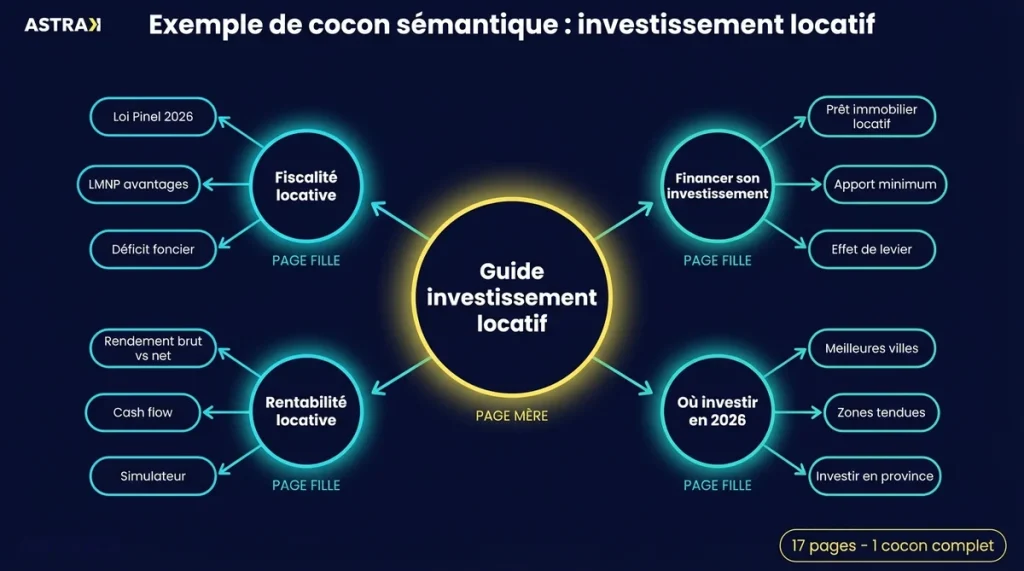
Here is an example of a concrete semantic silo for a real estate website who wants to position themselves on «Rental investment». This case illustrates the application of the semantic cocoon in practice, from structure to link strategy.
Page: «Complete Guide to Rental Investment in 2026
| Daughter page | Key expression target | Complementary pages (long tail) |
|---|---|---|
| Taxation of Rental Investment | real estate rental taxation | «Pinel Law 2026 conditions, LMNP tax advantages, How to declare a property loss» |
| How to finance a rental investment | Rental investment financing | «Rental property mortgage with no down payment», «How much to borrow for rental property», «Real estate leverage» |
| Calculate rental profitability | Rental profitability calculation | «Gross vs. Net Yield Difference», «What is Real Estate Cash Flow», «Rental Profitability Calculator» |
| Where to invest in rental properties in 2026 | Investing in rental property | «Best cities for rental investment,» «Investing in high-demand areas,» «Rental property in the provinces» |
Structure of internal links for this cluster:
- Each additional page contains 1 link to his/her parent page (Mandatory upstream link) + 1 link to a sister page in the same group if the context is appropriate.
- Each child page contains 1 link to the parent page (ascendant) + 1 link to each of its complementary pages (descendant) + optionally 1 link to a child sibling page.
- The parent page contains 1 link to each sub-page (4 descendant links), naturally placed within the content.
Total: 1 page boys + 4 pages girls + 12 supplementary pages = 17 pages. Each page targets a unique query, and the set covers the complete semantic field of rental investment.
Expected results: This type of silo, well executed with quality content and effective internal linking, can allow a site to go from zero to several hundred organic visitors per month on the target theme in 6 to 12 months. Complementary pages start to rank first (less competition), then authority gradually rises towards the child pages and the parent page.
What mistakes should you avoid to build a successful semantic cocoon?
A poorly constructed cocoon can be counterproductive. Here are the errors that sabotage most projects:
Create pages that are too close together and cannibalize each other.
If two pages in the cocoon target the same search intent, they compete in Google search results instead of reinforcing each other. Before creating a page, always check that no existing page already answers the same query. Each URL must have a unique role and a distinct target keyword.
2. Link all pages together without hierarchy
A mesh where each page links to all others is not a silo; it's a plate of spaghetti. Google no longer understands which page is the main one. Respect the ascending logic : complements for daughters, daughters to mother. The unstructured mesh dilutes authority instead of concentrating it.
3. Forget search intent in favor of volume
It's a classic mistake to build a cocoon solely by piling up keywords with a high search volume, without asking yourself what the user is really looking for. A page that doesn't respond well to the user's intention won't rank, even with perfect internal meshing. Each page should be useful for a real visitor.
4. Build a cocoon isolated from the rest of the site
A cocoon must be integrated into your website's overall architecture. If no pages outside the cocoon link to your parent page, it will lack incoming links, and Google will have difficulty finding it. Link your cocoon from your homepage, navigation menu, or service pages. The cocoon does not exist in isolation.
5. Publish then forget
Queries evolve, competitors publish new content, Google updates its algorithms. A high-performing semantic cocoon requires a Regular monitoring and adjustments. Update obsolete figures and data, add supplementary pages on emerging questions in «People Also Ask,» and strengthen the internal linking of underperforming pages.
What tools to use to build your semantic cocoon?
| SEO Tool | Use in the cocoon | Price |
|---|---|---|
| Semrush / Ahrefs | Keyword research, search volume analysis, competitive audit, position tracking | From 100 euros/month |
| YourTextGuru / Thot SEO | Semantic Content Optimization: Relevance Score, Lexical Field to Cover, SERP Competition Analysis | Starting from 30 euros/month |
| Cocon.se | Visualization of the cocoon structure and its internal mesh. Tool specifically dedicated to cocoon construction | Free (basic version) |
| Mindomo / XMind | Mind mapping to draw the tree structure of the cocoon before creation | Free / Freemium |
| Screaming Frog | Audit of existing internal linking, broken link detection, site structure analysis | Free (500 URLs) / 209 euros/year |
| Google Search Console | Performance tracking, page indexing, internal links detected by Google, ranked queries | Free |
For keyword research and competitive analysis, Semrush or Ahrefs are the references. For the semantic optimization of each page, YourTextGuru or Thot SEO allow you to verify that your content covers the lexical field expected by Google. And to visualize and audit your cocoon once it's online, Screaming Frog + Google Search Console provide all the necessary information on link structure and indexing.

Lift the technical brakes holding back your SEO
Indexing, speed, JS, schema, crawl: we're unlocking it all.
FAQ about the semantic cocoon
How many pages are needed for a semantic cluster?
A minimum viable cocoon contains 1 page main + 3 pages girls + 6 to 9 supplementary pages, which is 10 to 13 pages. But the right number depends on the subject matter: some require 15 pages to cover the topic, others 30. The important thing is to cover the lexical field relevantly and completely.
Can we make links between two different cocoons?
Yes, as long as the link is Relevant to the internet user And that the semantic proximity between the two pages justifies it. If a complementary page of a «technical SEO» cocoon mentions content strategy, a link to the parent page of a «Content marketing» cocoon is logical. The rule: the link must improve the visitor's browsing experience.
Should everything be published at once, or gradually?
Both approaches work. Publish the whole cocoon at once allows Google to immediately understand the complete structure. Phased publishing also works, provided that Start with the supplementary pages and back to the parent page. In this way, when the pillar page is published, it already benefits from the juice of its daughter pages.
How long does it take to see the results of a cocoon?
Count 3 to 6 months to observe the first significant effects on rankings. The delay depends on your domain authority, competition for target keywords, and content quality. Long-tail pages rank first, then authority climbs to the child pages and the parent page.
Does the semantic cocoon work for a small site or blog?
It's a meme for the low authority sites where the cocoon is most profitable. By focusing your efforts on one theme instead of scattering articles across different topics, you maximize the impact of each published piece of content. A blog with 3 well-structured topic clusters of 10 pages each will perform better than a blog with 50 unlinked articles.