


The PageRank is Google's founding algorithm who measures the importance of a web page by analyzing its incoming links. Although it has evolved considerably since its creation in 1996, the Google Leaks of 2024 confirmed that PageRank remains an active ranking factor in 2026, in the form of PageRank_NS. Here's how it works, how its formula is concretely calculated, and how to use it in your SEO strategy.
Topics covered in this article
Le PageRank is probably the most cited SEO concept and yet the most misunderstood. Many SEO professionals talk about it without mastering its calculation formula or its actual functioning within Google's algorithm.
This misunderstanding has direct consequences. Without knowing How PageRank distributes value among web pages, It's impossible to build a cohesive linking strategy. It's also impossible to explain why certain pages consistently rank better than others in search results, despite similar content.
The good news: the PageRank formula is actually accessible and logical. The concept is based on an elegant mathematical model, inspired by the academic citation system. And above all, the Google Leaks of 2024 have settled the debate: PageRank is still alive, in much more sophisticated forms than the original.
To build a strong link profile and to effectively distribute PageRank across your site, a professional netlinking strategy makes all the difference.
Book a meetingIn this article, we'll break down PageRank from A to Z. First, its definition and history, then its detailed calculation formula with a concrete example, the factors influencing the transmission of SEO juice, and finally, practical strategies to leverage it in 2026. Whether you're an SEO consultant or a webmaster, you'll leave with a solid understanding of this fundamental algorithm.
Google's PageRank, what is it?
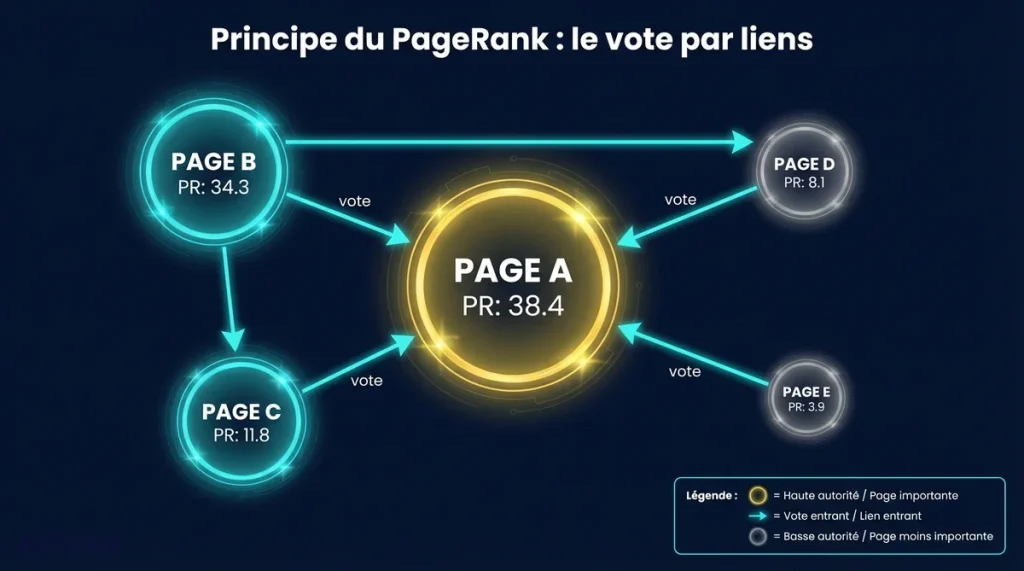
PageRank is a hypertext link analysis algorithm designed to measure the relative importance of each webpage on the internet. It is the technological foundation upon which Google built its search engine.
Its inventors: Larry Page and Sergey Brin, two doctoral students from Stanford University. In 1996, they published a research paper entitled «The Anatomy of a Large-Scale Hypertextual Web Search Engine» in which they first describe this algorithm. The patent is filed in 1998, the same year as the founding of Google.
The name «PageRank» has a deliberate double meaning. It refers both to the Web page concept and to Larry Page's name himself. A wink that has spanned decades.
The fundamental principle is simple: each hyperlink functions as a vote of confidence From one page to another. The more votes (backlinks) a page receives, the more important it is considered by Google. And not all votes are equal: a link from a high-authority site carries much more weight than a link from an unknown site.
The most striking analogy comes from the scientific world. In academic research, The more an article is cited by other publications, the more authoritative it is. in its field. PageRank applies exactly this principle to the web: links are citations, web pages are scientific articles.
Originally, Google displayed a PageRank score on a scale of 0 to 10 via the toolbar. This scale was logarithmic: going from PR 4 to PR 5 required many more quality links than going from PR 1 to PR 2. A site like Wikipedia reached PR 9, while most websites remained between PR 0 and PR 4.
It's important to keep in mind that PageRank is only’a factor among the 200+ criteria What Google uses in its ranking systems. Content relevance, user experience, and information quality all count in the final ranking of search results.
How PageRank is Calculated: The Step-by-Step Formula
The calculation of PageRank is based on a mathematical formula published by Larry Page and Sergey Brin in their foundational paper. Here is the original formula for the PageRank algorithm:
Let's break down each variable:
- PR(A) PageRank of page A, which we are trying to calculate
- d (damping factor) : fixed at 0.85 by default. It represents the probability that a user will continue clicking a link rather than typing a new URL. It is the heart of the model. random surfer paradox
- PR(Ti) The PageRank of each page Ti that links to page A
- TiC the total number of outbound links on the page
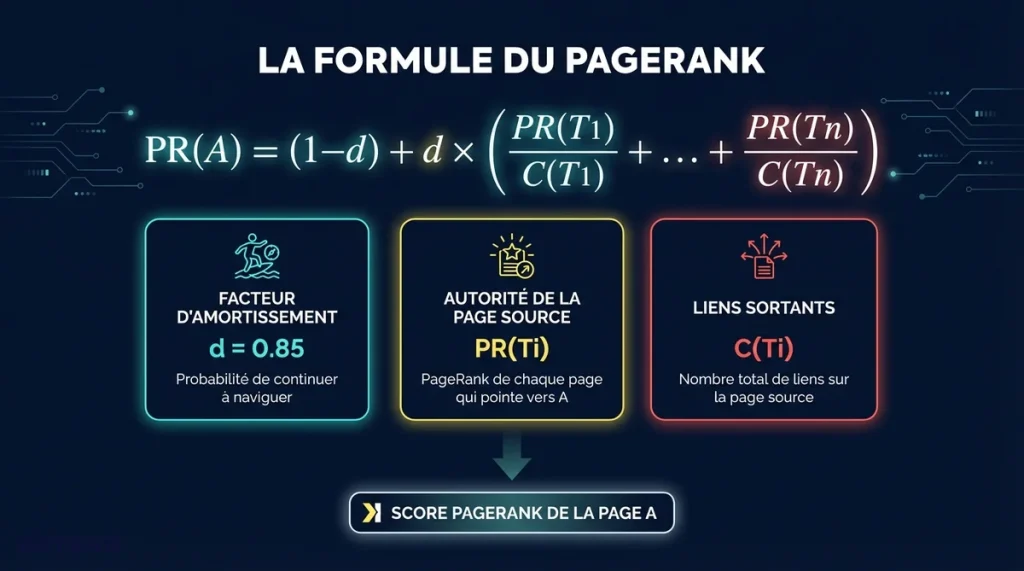
In short, A page's PageRank depends on the PageRank of the pages that cite it, divided by the number of outgoing links from those pages. The more authority the source page has and the fewer outgoing links it has, the more value it passes on.
The model of Random surfer gives a concrete interpretation. Imagine a web surfer browsing the web at random, clicking on links. On each page, he has an 85 % chance of clicking on a link (the damping factor) and a 15 % chance of returning to a totally random page. The PageRank of a page corresponds to the probability that this surfer will end up on this page at a given moment.
The calculation is iterative. First, an equal value is assigned to each web page in the network, then the formula is applied, recalculated, and repeated until the scores stabilize. This is called convergence.
Concrete example of PageRank calculation
Let's take a simplified network of 4 pages (A, B, C, D) with the following links:
- Page A receives links from B and C
- Page B receives a link from A
- Page C receives links from A and D
- Page D receives a link from C
Each page is initialized with a PageRank of 0.25 (1/4 of the total). With a damping factor of 0.85, here is The first 3 iterations of the calculation :
| Page | Initialization | Iteration 1 | Iteration 2 | Iteration 3 |
|---|---|---|---|---|
| Page A | 0.250 | 0.363 | 0.390 | 0.396 |
| Page B | 0.250 | 0.256 | 0.316 | 0.318 |
| Page C | 0.250 | 0.363 | 0.319 | 0.327 |
| Page D | 0.250 | 0.363 | 0.319 | 0.289 |
After convergence, the Page A gets the highest PageRank because it receives links from two pages. This table illustrates how the PageRank algorithm redistributes authority within a network of interconnected pages. Each iteration refines the scores until a stable equilibrium is reached.
What the damping factor changes in practice
The damping factor of 0.85 has a direct consequence on the SEO juice distribution : with each «jump» from one page to another, 15 % of the PageRank value is lost.
Concretely, if a high-authority page A links to page B, which in turn links to page C: Page C is getting significantly less SEO juice than page B. This is exponential decay.
For SEO, this means that the further a page is from your main authority sources (your homepage, your most linked pages), the less PageRank it benefits from. This is why a flat website architecture, with few levels of depth, promotes better PageRank distribution across all your web pages.
What factors influence PageRank transfer?
Backlink quality matters more than quantity
Not all links transmit the same dose of PageRank. A single backlink from a high-authority site (national press, corporate site, online encyclopedia) can be worth more than hundreds of links from low-popularity sites.
The reason is mathematical: the score transmitted is proportional to the PageRank of the source page. An article on a major medium with a high internal PR transmits a considerable SEO. Conversely, a link from a blog with no traffic or backlinks transmits almost nothing.
Thematic relevance also plays a key role. Google values links coming from sites whose content is in relation to your theme. A cooking site that receives a link from a car blog will benefit less than a link from a food magazine.
The role of the number of outbound links
The formula is clear on this point: the PageRank transmitted by a link is divided by the total number of outgoing links from the source page. This is the principle of dilution.
Numerical example: a page with a high pagerank score (equivalent to PR 6) containing Only 2 outbound links transmits about 50 % of its PR to each linked page. The same page with 20 outbound links now transmits only 5 % per link. The difference in transmitted value is considerable.
That's why, in netlinking, a link on a page that contains only a few outbound links is far more valuable than a link embedded in a page packed with links. Resource pages with 200 outgoing links offer a very diluted PageRank transmission.
Nofollow, sponsored, UGC links: what impact on PageRank?
The nofollow, introduced in 2005, historically told search engines not to pass PageRank through that link. Webmasters used it to control the distribution of their SEO juice.
But Google evolved its position in 2019. Since that date, nofollow has been treated as a «hint» and no longer as a strict directive. Google may choose to follow or ignore this attribute at its own discretion. In practice, some nofollow links probably do pass PageRank.
Two new attributes have been introduced in parallel:
- rel=»sponsored» for paid and advertising links
- rel=»ugc» for user-generated links (comments, forums)
These attributes serve as Signals to help Google understand the nature of the link. No PageRank transfer is officially confirmed for these types of links, but the system remains opaque.
Internal Linking: Distributing PageRank Across Your Site
Internal linking is the most accessible lever for redistribute PageRank within your own website. Each internal link transfers a fraction of the source page's value to the destination page.
The orphan pages (pages without any internal links pointing to them) are a direct waste of PageRank. They are invisible to the distribution system and receive only the minimum score guaranteed by the damping factor.
An effective strategy is to create pillar pages who centralize authority and redistribute it to satellite pages via a structured internal linking. Your most externally linked pages should point to your strategic pages for positioning.
Use descriptive and relevant anchor text for your internal links. The link anchor helps Google understand the topic of the target page and reinforces the relevance of the signal transmitted.
To build a strong internal mesh and to effectively distribute PageRank across your site, a professional netlinking strategy makes all the difference.
Book a meetingIs PageRank still a Google ranking factor in 2026?
The discontinuation of the PageRank toolbar in 2016
Google has stopped publicly updating the Google Toolbar PageRank score in 2013. The last visible update dates back to December 2013: after this date, the scores displayed have remained fixed.
In 2016, Google officially retired the toolbar PageRank from their browser. There is no longer any way to check a web page's score via Google's tools. This decision aimed to limit manipulation practices and link trading based solely on the displayed PR.
The original PageRank patent, filed by Stanford University and attributed to Larry Page, has expired in 2018 without being renewed. Some saw it as the definitive end of PageRank. They were wrong.
The Google Leaks of 2024: PageRank_NS revealed
In March 2024, a Massive leak of internal Google API documents shook the SEO community. Thousands of pages of technical documentation were made public, revealing the inner workings of Google's ranking systems.
Major discoveries include: several active versions of PageRank appear in the documentation. These include RawPageRank, PageRank2, and especially PageRank_NS.
PageRank_NS (Nearest Seed) is the most interesting version. Its PageRank algorithm is based on a concept of «seed pages»: Google manually selects trusted pages (government sites, major media, institutions) that serve as a reference base. A page's PageRank is then calculated according to its proximity to these seed pages in the link graph.
The conclusion is clear: Google's PageRank is still alive in 2026, in a much more sophisticated form than the original 1996 algorithm. The importance of PageRank in ranking results has not disappeared; it has become more complex.
Alternative metrics for estimating PageRank today
Since Google no longer communicates public PageRank, several SEO tool publishers have developed their own indicators of authority. Here are the main ones:
| Metric | Editor | Scale | What it measures |
|---|---|---|---|
| Domain Authority (DA) | Moz | 0-100 | Global Domain Authority |
| Domain Rating (DR) | Ahrefs | 0-100 | Backlink profile strength |
| Trust Flow (TF) | Majestic | 0-100 | Backlink Quality and Trust |
| Citation Flow (CF) | Majestic | 0-100 | Volume and quantity of links |
These metrics are useful for Compare website popularity against competitors and to guide a link building strategy. None of them reflect the true PageRank of a page as Google calculates it internally, but they offer reliable approximations to guide your decisions.
Check your Search Console to directly observe the impact of your backlinks on your rankings. This is the most reliable source of information, directly provided by Google. Don't hesitate to contact an SEO expert to interpret this data correctly.
How to improve your site's PageRank in practice

Building a quality backlink profile
The first step to increasing a site's PageRank is to getting links from high-authority sites, In relation to your theme. An effective link-building strategy targets diversified sources: online press, specialized blogs, professional directories, and industry partners.
The diversity of anchor text is an essential criterion. Vary your anchors between the brand name, generic expressions («click here,» «learn more»), thematic anchors, and targeted keyword anchors. anchor sub-optimization constitutes a negative signal for Google and can lead to penalties.
Prioritize consistency over spikes. A backlink profile that grows naturally and progressively seems more credible in the eyes of the algorithm than a massive acquisition of links in just a few days.

Boost your authority with premium backlinks
Targeted strategy, optimized anchors, measurable ROI.
Optimize Your Internal Linking
Internal meshing is your most direct leverage for Distribute SEO juice among your pages. Unlike backlinks, you have total control over your internal links.
Start with identify your orphan pages. These are pages that receive no internal links and remain invisible within your site's structure. Tools like Screaming Frog or Sitebulb detect them automatically. Each orphaned page that is corrected recovers PageRank.
Structure your content to thematic clusters. A central pillar page addresses a broad topic and links to satellite articles that delve into sub-topics. This interlinking creates a network of relevance that Google values in its rankings.
Use Descriptive anchors for your internal links. Rather than a generic «click here,» write a link that describes the content of the target page. This strengthens the topical signal and helps Google better understand your site's structure.
Create content that attracts links naturally
The linkbait content« The goal is to generate backlinks without any active effort. The idea is to produce resources that are so useful, original, or surprising that webmasters cite them spontaneously.
Formats that work best for natural link acquisition:
- Original studies and exclusive data sectoral surveys, statistical analyses, annual barometers
- Free interactive tools calculators, generators, simulators
- Infographics and visual content graphic syntheses of complex data
- Comprehensive and definitive guides Reference content on a specific topic
The best backlink is one that isn't requested. High-quality content that precisely answers an informational need generates natural backlinks, the most positive signal for improving your PageRank in the long term.
Frequently Asked Questions about PageRank (FAQ)
Can we know the exact PageRank of a page?
No. Google no longer communicates the PageRank score since 2013. Tools like Moz (Domain Authority) or Ahrefs (Domain Rating) offer alternative metrics, but none reflect Google's true internal PageRank. These indicators remain useful for comparing the relative popularity between sites.
Who invented PageRank?
Larry Page and Sergey Brin PageRank was invented in 1996 at Stanford University. The algorithm was patented in 1998 and forms the technological foundation of Google. The name «PageRank» pays homage to Larry Page's last name.
Is PageRank the most important SEO factor?
No. PageRank is a factor among more than 200 used by Google search engines. Content relevance, user experience, and EEAT signals matter as much, if not more, in ranking results. A comprehensive SEO strategy combines all these criteria.
How many backlinks are needed for a good PageRank?
There is no fixed number. One link from an authoritative site is worth more than hundreds of low-quality links. Quality, topical relevance, and source diversity matter more than raw backlink volume.
What is the difference between PageRank and Domain Authority?
The PageRank is Google's internal algorithm, not publicly accessible. Domain Authority (Moz) is a third-party metric that estimates a domain's authority on a scale of 0 to 100. Both measure popularity by links, but in a completely independent manner.
Do you want to strengthen your site's authority with a custom internal linking strategy?