

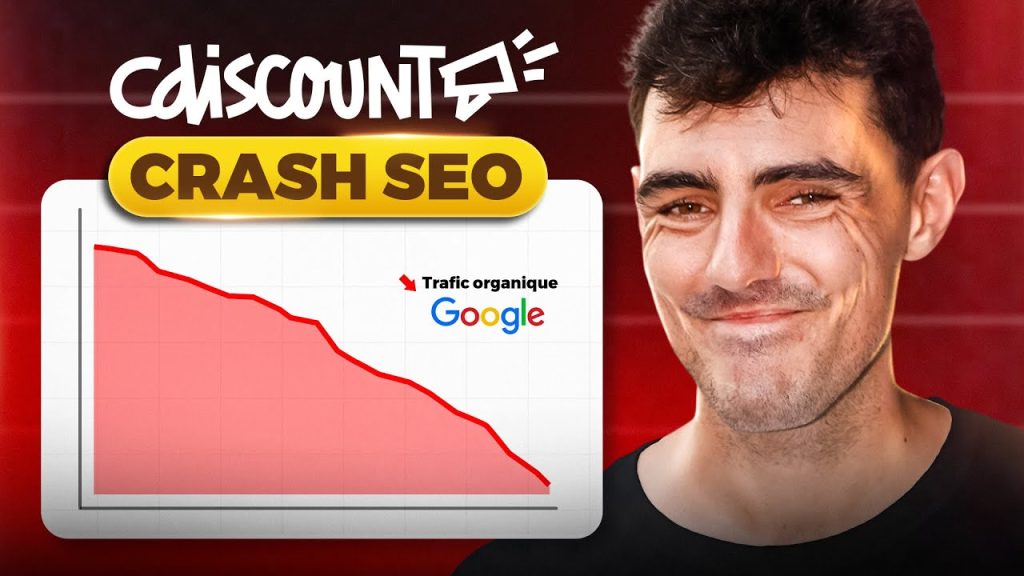
This is one of the most frightening charts in current French SEO. The organic traffic curve for Cdiscount, once the undisputed leader in e-commerce in France, shows a dizzying drop. The site has gone from total domination with nearly 20 million monthly visitors (a massive portion of which are non-branded) to diminishing visibility on generic queries.

Contrary to rumors, this nosedive is not due to a brutal Google algorithm update (Core Update) that would have penalized the content. Technical analysis reveals a more insidious cause: an internal architectural change that made the site invisible to bots.
In this case study, we will dissect the two engineering mechanisms that led to Cdiscount's success, before analyzing the fatal technical error that caused its current decline.
Secret #1: Dexing Search (The art of being first before everyone else)
Cdiscount's greatest historical strength lay in its ability to create pages before its competitors even knew a product existed. This technique is called Search Dexing.
The automatic generation mechanism
The principle was based on the exploitation of internal research data From the site. Rather than waiting for an SEO manager to manually create a category, Cdiscount's algorithm did it automatically according to a strict process:
1. Detection
A user types a query into the site's search bar (e.g., «Redmi Note 13 Pro» or «Hand Spinner»).
2. Purchase Validation
If this search resulted in a conversion (purchase), the system considered the query relevant.
3. Security filtering
The algorithm checked that the term was not a forbidden trademark, adult content, or a gross misspelling.
4. Creation
An indexable page was automatically generated, optimized for this specific keyword.
The Competitive Advantage: The Hand Spinner Example

This strategy offered unbeatable responsiveness. When a viral trend like the «Hand Spinner» emerged, Cdiscount already had an optimized and indexed page while other sites hadn't yet created a dedicated section. The site thus captured 100%% of the nascent traffic.
System Risks (Spider Traps)
This extreme automation was not without its dangers. It sometimes generated thousands of unnecessary or duplicate pages.
Example: The system generated a high-performing page for the query «XNXN» (a typo for a well-known adult site XNX), simply because a user had purchased a product after that search. Cdiscount found itself in the top 10 for this incongruous query, generating massive but poorly qualified traffic.
Secret #2: Obfuscation and Indexable Facets
With over 50 million potential pages, Cdiscount couldn't afford to let Google crawl just anything. Crawl budget management (the time Google spends on your site) was handled with surgical precision thanks to two techniques.
1. Mesh Cloaking (Watertight Siloing)
In its heyday, Cdiscount used an advanced link obfuscation technique.
- The principle: The menu the user saw was not the one Google saw.
- The application: On the homepage, everything was open. But as soon as you entered a category (e.g., Home Appliances), the menu would «close.» A link to «Video Games» disappeared from the HTML code for Google.
- The profit: This created perfect thematic silos. The SEO power (the juice) remained concentrated in the semantic universe of the Washing Machine without diluting into irrelevant categories.
2. Indexable Facets (Turning Filters into Gold)
On an e-commerce site, faceted filters (Brand, Price, Color) are often an SEO nightmare that generates duplication. Cdiscount has reversed this trend by selecting which facets should become pages.
- Smart sorting: If search volume existed (e.g., «Washing machine 6kg»), the facet would generate clean, indexable URLs.
- Noise cancellation If the combination had no SEO value (e.g., «Asco washing machine»), the link remained in JavaScript and was not followed by Google. This allowed us to perfectly meet market demand without wasting server resources.
The Collapse: Why the New Menu Killed SEO
If these techniques were so effective, why did traffic collapse? The answer lies in the technical redesign of the site, and particularly in the management of the Mega Menu.
The Phantom Menu
When updating to the new interface (around 2022-2023), Cdiscount switched its main menu entirely to JavaScript, which is often complex to load.
- The technical assessment: Upon inspecting the site today, we realize that links to major categories (like IT) are no longer hardcoded (classic href) from the homepage for the Google bot.
- The consequence: Google can no longer naturally «descend» the tree. The royal path to deep categories has been cut off.
Mesh dispersion
Instead of a clear pyramidal structure, the site now disperses its juice via:
- Bulk products: The internal mesh is massively pushing individual product listings rather than parent categories.
- «Noindex» pages: Many promotional categories (Sales, Special Operations) are linked from the homepage... but have a «noindex» tag, telling Google not to consider them. This is a dead loss of power.
Result: A 50% drop in off-brand traffic
By breaking its link architecture, Cdiscount made its own sections difficult for search engines to find. «Brand» traffic (people typing «Cdiscount») is holding steady, but «off-brand» traffic (new customers typing «Samsung TV») has collapsed.

Lift the technical brakes holding back your SEO
Indexing, speed, JS, schema, crawl: we're unlocking it all.
Action Plan: 3 Lessons to Apply to Your Website
The history of Cdiscount teaches us three golden rules for E-commerce SEO in 2025:
1. Never unintentionally obscure your main menu
If you're using JavaScript for your menu (Mega Menu), ensure that the links are always legible in the source code (tags <a href="/en/.../">If Google cannot crawl the menu, it cannot see your products.
2. Use your internal search
Analyze the keywords typed into your site. If a query appears often and you don't have a dedicated category page, create one immediately. This is a guaranteed traffic opportunity.
3. Control your facets
Do not let Google index all filter combinations. Only allow indexing for combinations that have actual search volume (Brand + Product Type) and block others (Price, overly specific dimensions).
I spent a year doing an apprenticeship at Cdiscount. Since then, I've built my career in SEO and started my own agency. I wanted to see how they had evolved. Surprised by the results, I found it to be an excellent SEO case study!

Ready to accelerate your SEO?
I can perform a quick audit of your technical structure to ensure you are not making the same mistakes as the French giant.