
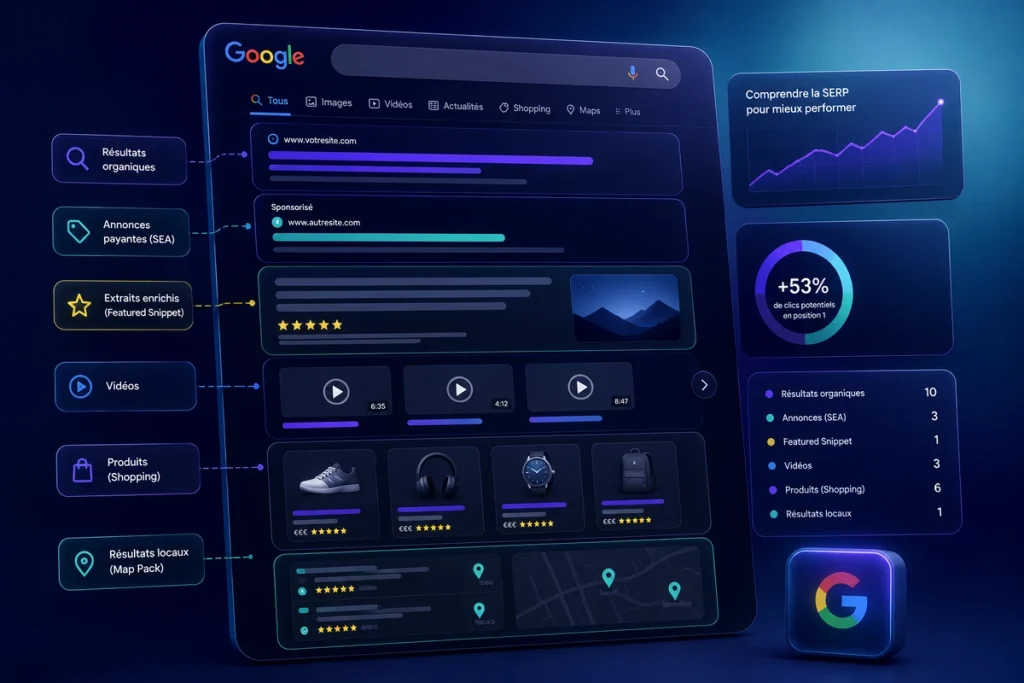
SERP (Search Engine Results Page) is the Google search results page after each search. In 2026, it is no longer limited to 10 blue links: it integrates Sponsored results, AI Overviews, Featured Snippets, Local Packs and many other modules. The organic position 1 captures approximately 39,8 % clicks, while the first paid link only captures 6 %. Understanding the SERP means understanding where your site's visibility is determined.
You type a keyword into Google, press Enter, and a page appears. That page is the SERP. However, 94 % marketing professionals do not know how to identify all the elements that make up the SERP. This is a problem: each module on the SERP represents an opportunity to capture qualified traffic or, conversely, to lose it to a competitor.
In 2026, the Google SERP has evolved considerably. The arrival of AI Overviews reduced organic CTR by 61% on certain queries (Seer Interactive study, 2025). «Zero-click» searches now represent over 60% of queries. Ignoring these changes is like driving your positioning strategy blindly.
This guide breaks down each component of a Google SERP, with figures to back it up, so you know exactly where to focus your SEO efforts.
What exactly is a Google SERP?
SERP is the acronym for Search Engine Results Page, which translates to «Search Engine Results Page» in French. Specifically, it's the interface that Google displays after a user has entered a query into the search bar.
Historically, the SERP boiled down to 10 blue links ranked by algorithmic relevance. In 2026, this era is over. A modern SERP can contain up to 15 different types of modules on a single page: organic results, paid ads, AI Overviews, featured snippets, local packs, People Also Ask, Knowledge Panels, video carousels, Shopping results, and more.
Each SERP is unique and personalized based on three main factors:
- Geolocation A search for «Italian restaurant» in Paris and Lyon will not produce the same SERP. Google displays Google Business Profile listings in 7 out of 10 results for local queries.
- Browsing history If the user is signed into their Google account, the search engine customizes results based on their previous searches and Chrome browsing habits.
- The device used Mobile rendering favors short videos and local results, while desktop displays more textual results and comparison tables.
The key takeaway: Two people typing the same query at the same time can see a totally different SERP. It is for this reason that SERP analysis has become a discipline in its own right in SEO.
What are all the elements of a Google SERP?
Here is a comprehensive inventory of every module you can encounter on a SERP in 2026, with its role and impact on your visibility.
Organic Results (SEO)
These are the natural links classified by the Google algorithm according to their relevance to the query. Each organic result consists of three visible elements:
- The title tag (clickable blue title): this is the element with the strongest correlation to ranking (0.75 according to Google Leak data). Placing the exact keyword at the beginning of the title tag significantly improves ranking chances. To optimize your titles, consult our Ranking Factors Guide.
- The URL displayed (in green/gray): it shows the path to the page and gives a signal of confidence to the user.
- The meta description (gray text): this has no direct impact on ranking, but serves as an advertising argument to encourage clicks. Google rewrites it in 62 % of cases if it doesn't match the search intent.
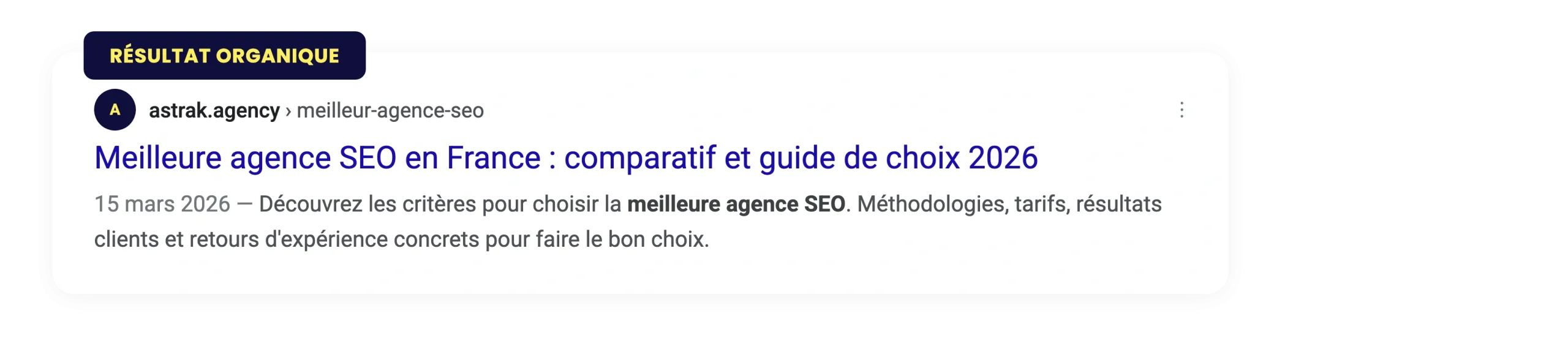
In 2026, organic results are increasingly pushed further down by new modules (AI Overviews, ads). Despite this, the top 3 organic positions capture 68.7 % of all clicks (Backlinko, 2026).
Sponsored results (SEA/Google Ads)
Located at the top and bottom of the SERP, sponsored results are identified by the mention «Sponsored» In bold. They include:
- Classic text ads : similar format to organic results but with an ad badge.
- Google Shopping Blocks Product carousels with image, price, and merchant name, powered by Merchant Center.
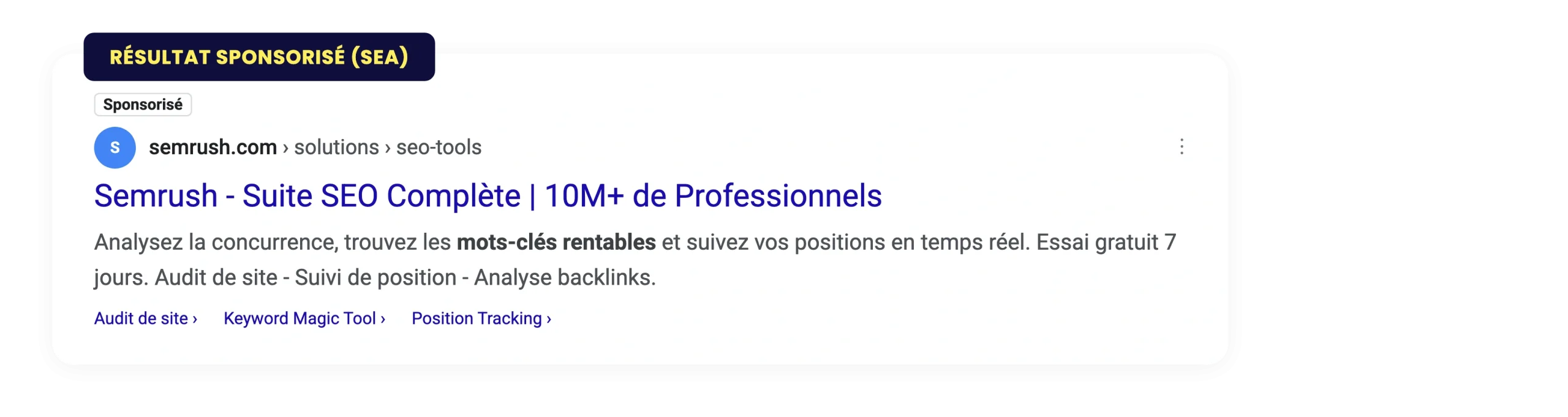
The first sponsored link captures on average 6 % of search volume, which can rise to 8 % with excellent copywriting. A 2025 HubSpot study reveals that 70 to 80 % of users ignore ads to scroll down to organic results. However, for high purchase intent queries, 65 % of users end up interacting with a SEA link at some point in their journey.
AI Overview (formerly SGE)
This is the major change of 2025-2026. The’AI Overview is an AI-generated summary from Google, displayed directly at the top of the SERP to answer the query without the user needing to click on a site.
The numbers speak for themselves:
- In February 2026, AI Overviews will appear on 48 % requests tracked (compared to 31 % a year earlier).
- Organic CTR on queries with AI Overviews has dropped by 1.76 % to 0.61 %, a 61 % decline (Seer Interactive).
- Paid CTR also dropped by 68 %, from 19.7 %to 6.34 %.
- Pure news sites and «how-to» guides are the most affected, with a estimated traffic decrease of -40 %.
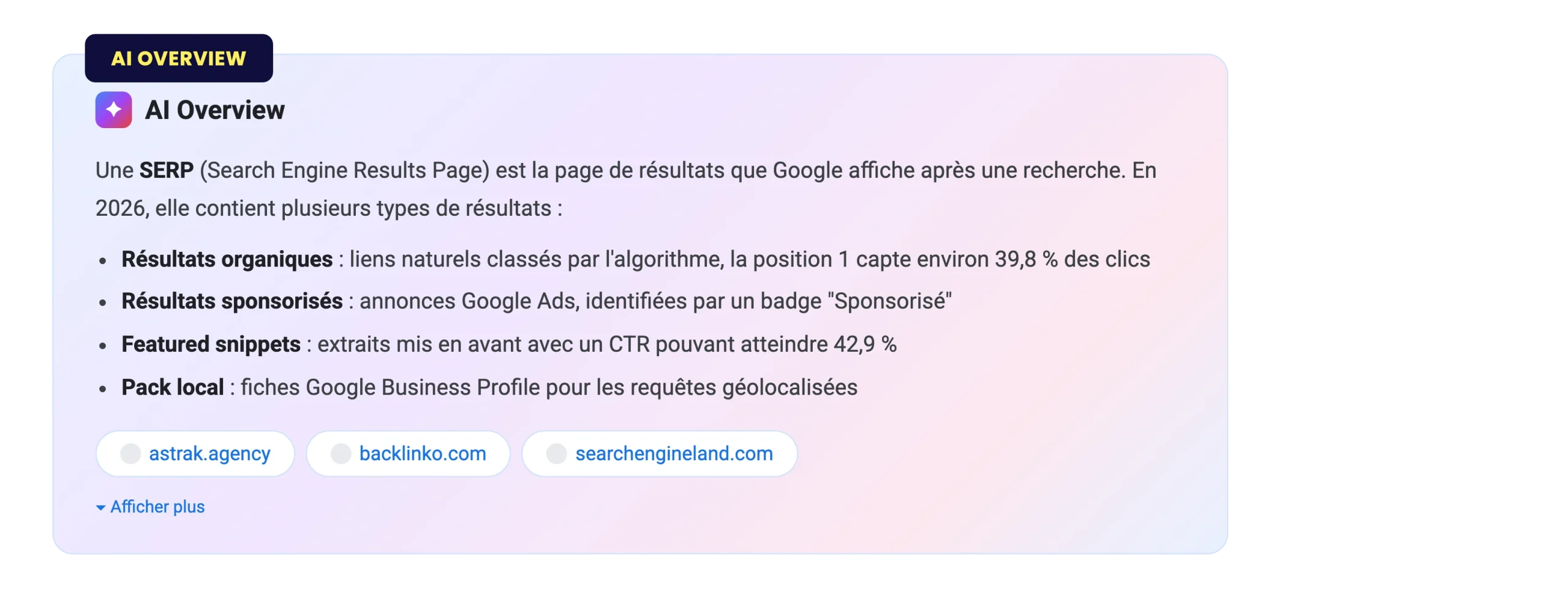
Positive point: Brands mentioned in an AI Overview gain. 35 % de clics organiques supplémentaires and an additional 91 % paid clicks. Being featured in the AI Overview can generate more qualified traffic than ranking in the traditional third position. That’s why the GEO (Generative Engine Optimization) strategy is becoming essential.

Be quoted by ChatGPT, Perplexity, and Gemini
60%: Some searches don't require a click. You are selected by AI.
Featured snippets (zero position)
The featured snippet is a Featured excerpt appears above the classic organic results. Google pulls it directly from the content of a page to answer the user's question. There are three main formats:
- The paragraph A text block of 40 to 60 words that directly answers the query.
- The list (Ordered or not): used for steps, rankings, or lists of items.
- The table Displayed when the query involves a structured data comparison.
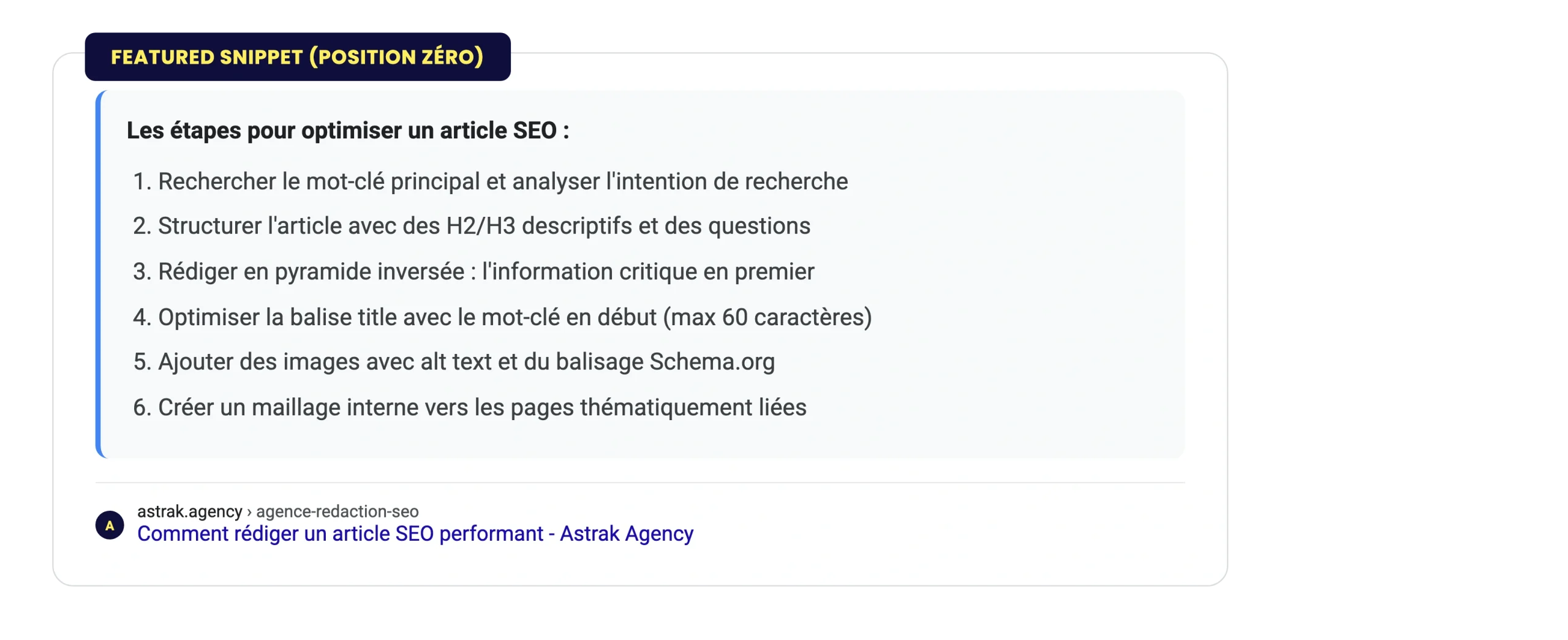
A featured snippet achieves a CTR of 42,9 % According to Backlinko, this makes it the module with the best click-through rate on the entire SERP. To obtain it, the page must already rank in the top 10 and answer the question asked concisely and in a structured manner.
People Also Ask (PAA)
The block «Other frequently asked questions» Display a dropdown list of questions related to the initial query. Each question, when clicked, unfolds an answer snippet from a website, with a link to the source.
The PAAs are present on over 85 % of SERPs in 2026. They represent a major SEO opportunity because:
- They are Dynamics each click generates new related questions.
- They allow you to appear in SERPs even without being in the top 10 classic.
- They directly feed the understanding of’search intent Internet users.
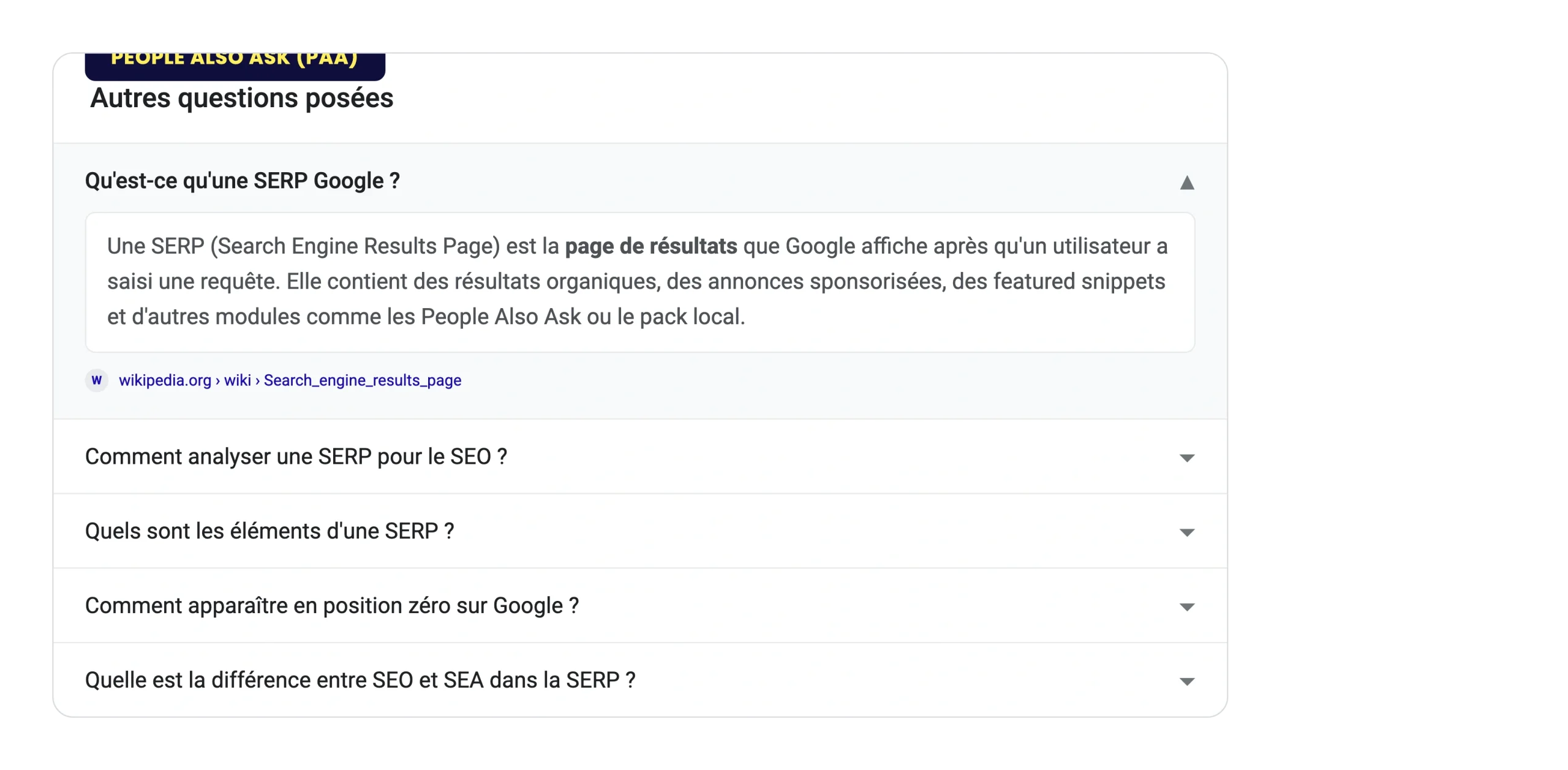
Integrate these questions into your semantic cocoon is an effective strategy for capturing additional traffic.
Local pack (Google Maps)
For requests to local intent (e.g., «plumber Paris», «Japanese restaurant Lyon»), Google displays a block of 3 business listings with an interactive map, reviews, hours, and contact information. This block comes from the listings. Google Business Profile (formerly Google My Business).
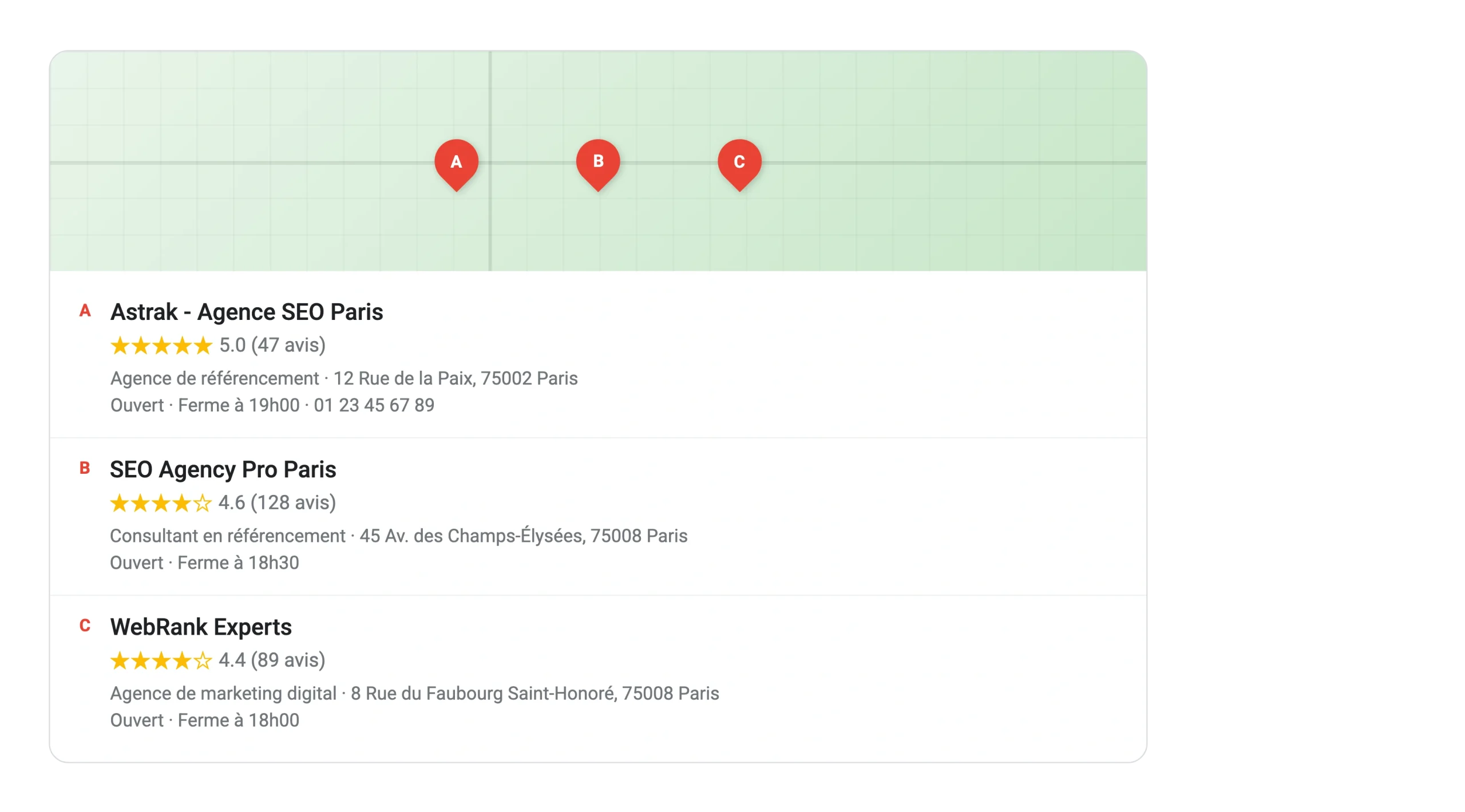
The local pack is decisive for local SEO: it appears before traditional organic results and captures a significant share of clicks, particularly on mobile where it takes up almost the entire screen.
Capture customers searching near you
Master "[service] + [city]". Calls, visits, real clients.
The Knowledge Panel
The Knowledge Panel appears to the right of the results (on desktop) or at the top (on mobile) for entities recognized by Google businesses, personalities, places, organizations. It draws its data from Knowledge Graph from Google, powered by Wikidata, Wikipedia, and other structured sources.
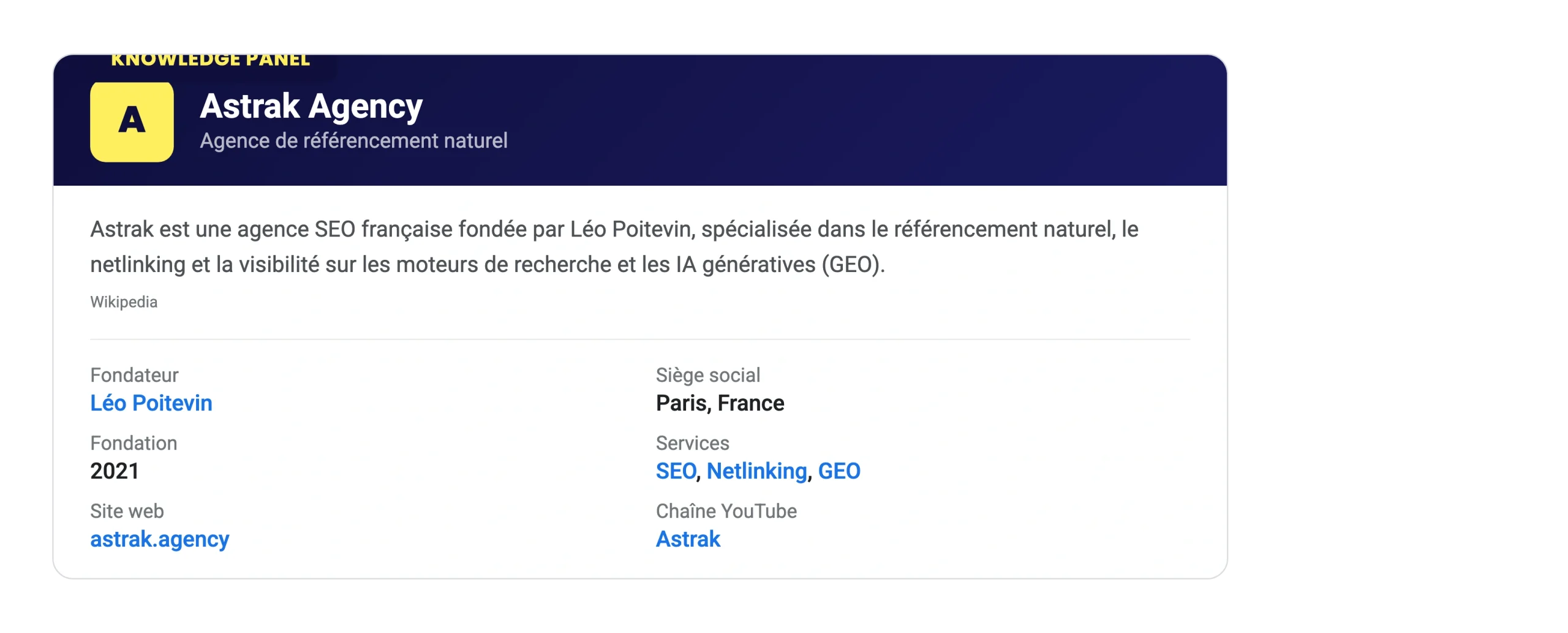
To appear in a Knowledge Panel, your entity must be referenced in the Knowledge Graph. This is a powerful signal of authority that strengthens your credibility (E-E-A-T) and brand visibility. More details on the Knowledge Graph and its importance in GEO.
Rich Snippets
Rich snippets add additional visual information to classic organic results thanks to Schema.org markup. The most common formats:
- Rating stars Average rating and number of reviews (e.g., ★★★★☆ 4.2/5 – 1,230 reviews).
- Prices price range for products and services.
- Recipes Preparation time, calories, photo.
- The events Date, location, seat availability.
- FAQs : questions/answers directly below the result.
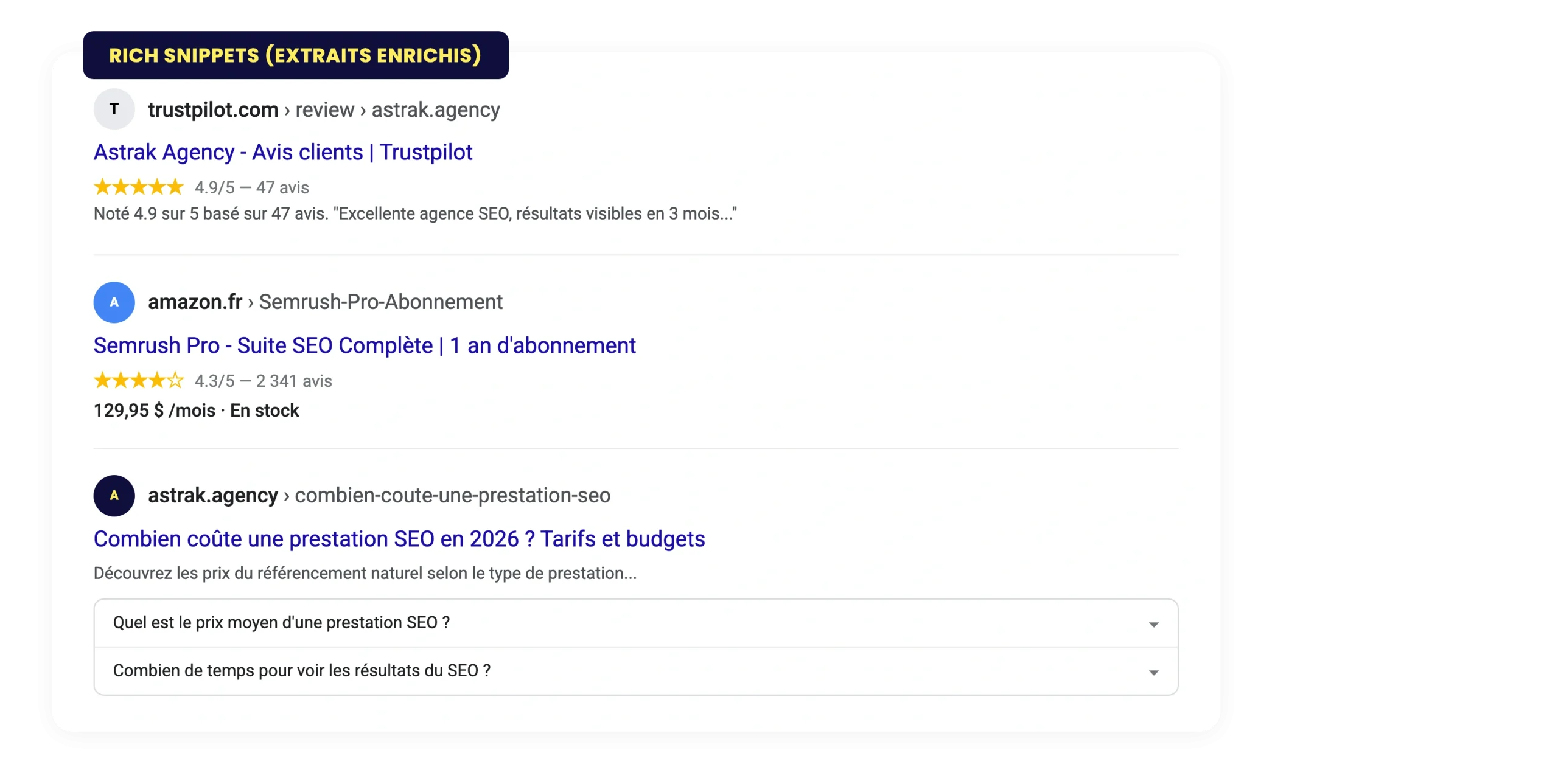
Rich results with stars can increase CTR by 20 to 30 % Compared to a result without enrichment. Structured markup is handled by SEO plugins (Yoast, Rank Math) or implemented manually in JSON-LD.
The other SERP modules
According to the query, Google can also display:
- The video carousel : YouTube video block, particularly frequent for tutorials and «how-to» searches.
- Google News : real-time news results block for hot topics.
- Sitelinks Internal site links displayed below the main result, typically for branded queries.
- The Image Carousel Clickable image gallery at the top of the SERP for visual queries.
- Related searches : related queries at the bottom of the page.
Organic CTR vs. Paid CTR: Key Figures in 2026
Here is the most recent data on click distribution in Google SERPs, from leading studies in 2025-2026.
CTR by organic position
| Organic position | Average CTR (Backlinko 2026) | Average CTR (First Page Sage 2026) |
|---|---|---|
| Position 1 | 39,8 % | 27,6 % |
| Position 2 | 18,7 % | 15,8 % |
| Position 3 | 10,2 % | 11,0 % |
| Position 4 | 7,4 % | 8,4 % |
| Position 5 | 5,1 % | 6,3 % |
| Positions 6-10 | 1.5 % – 3.9 % | 2,1 % – 4,9 % |
| Page 2 | 0.78 % (Ahrefs) | < 1 % |
| Featured Snippet | 42,9 % | – |
The conclusion is undeniable: The first organic result receives 19 times more clicks than the first paid result.. And the top 3 positions alone capture 68.7 % of total clicks. Being on page 2 is practically equivalent to not existing: 0.78 % CTR.
Organic vs. Paid: The Gap Widens
2025-2026 data confirms the dominance of organic:
- 94 % of internet users scroll past sponsored ads to click on organic results.
- The first paid link captures 6 % of search volume on average, compared to 39.8 % for the first organic.
- 70 to 80 % of users systematically ignore ads (HubSpot, 2025).
However, ads remain relevant for high transactional intent queries. The average cost per click (CPC) has reached 5.26 $ in 2025 (WordStream), up 12.9 % year-over-year, with 87 % sectors affected by this inflation.
The Impact of AI Overviews on CTR
AI Overviews are the biggest click distribution disruptor:
- -61 % organic CTR on queries with AI Overviews (Seer Interactive, 2025).
- -68 % paid CTR on these same requests.
- When an AI Overview is present, the organic position 1 CTR can to fall from 39.8 % to about 30 %.
- Informational queries are the most affected: AI Overview appears in them 39,4 % des cas.
According to Gartner's projections, 25 % of organic traffic will migrate to AI chatbots and voice assistants by the end of 2026. This trend makes the Visibility strategy in LLMs essential.
How to analyze a SERP for your SEO strategy?
Analyzing the SERP before creating content is fundamental. Here's the 4-step method.
Step 1: Identify the search intent
Google categorizes each query according to 4 types of intention :
- Informational The user wants to understand («what is a SERP», «how does Google work»). The SERP displays blog posts, guides, and People Also Ask sections.
- Navigational The user is looking for a specific website («Facebook login,» «Amazon»). The SERP displays the site in question with its sitelinks.
- Transactional the user wants to buy («buy iPhone 16», «best VPN price»). The SERP displays Shopping, ads, and comparisons.
- Commercial : the user compares before buying («Semrush reviews», «Ahrefs vs Semrush»). The SERP shows comparisons, reviews, and lists.
The composition of the SERP directly tells you the Expected content format by Google. If the SERP shows 8 «how-to» guides and 2 videos, there's no point in producing a product page: Google expects informational content.
Step 2: Analyze the competition.
For each of the top 10 results, note:
- The page type Blog post, landing page, product sheet, category page.
- The length of the content Count the words to calibrate your own content.
- The Hn structure Identify the H2/H3s to understand the subtopics covered.
- Visual elements : charts, infographics, embedded videos.
- Domain Authority Assess the power of the positioned domains to gauge competitiveness.
From SEO tools like Ahrefs, Semrush or AI SEO tools allow this analysis to be automated.
Step 3: Identify SERP opportunities
Search for SERP modules you can target:
- Featured snippet absent or low quality Structure your content to capture it (concise paragraph under the H2 that directly answers the question).
- PAA without strong source Integrate these questions as H2/H3 into your article.
- No video, even though the subject is suitable for it. Create a complementary video to fill the video carousel.
- Local package present, but poorly optimized files Optimize your Google Business Profile.
Step 4: Monitor SERP Volatility
SERPs are not fixed. They evolve based on algorithmic updates (Core Updates), seasonal trends, and the progressive expansion of AI Overviews. Use the Google Search Console to track your impressions, your CTR, and your average position per query.
SERP USA vs SERP France: What are the differences?
Google SERPs are not identical across countries. Here are the main differences between the US and French markets:
| Criteria | SERP USA | SERP France |
|---|---|---|
| AI Overviews | Present in 48 % of the queries | More limited deployment, about 25-30 % |
| Number of ads | Up to 4 ads on top | Generally 2-3 ads at the top |
| Shopping results | Very present (mature e-commerce) | Present but less dominant |
| Local pack | Standard 3-pack format | 3-pack format with Google reviews |
| Organic competitiveness | Extremely high | High but more opportunities |
| SafeSearch by default | Activated for minors | Activated for minors |
The French market still offers positioning opportunities that the US market no longer offers. French sites with quality content and a strong Link building strategy solid can still reach the top 3 on competitive queries, where US competition makes this ambition much more costly.
SafeSearch and Google's Double Index
Google manages what is called a double index :
- The primary index : contains «healthy» results, approved for all audiences.
- Secondary index adult (+18), dating or «borderline» content.
When the SafeSearch filter is activated, the secondary index results are totally filtered or blurred. On certain ambiguous queries (e.g. «rencontre»), Google can switch from one index to another depending on the context and user parameters.
For SEO professionals, this means that the same keyword can produce two totally different SERPs depending on whether SafeSearch is enabled or not. Always check both versions when analyzing an SERP for a potentially ambiguous query.
Google's special interactive SERPs
Google sometimes displays Special SERPs with interactive or playful elements
- Easter Eggs For example, type «do a barrel roll» and the page rotates. Type «Pac-Man» and a mini-game appears directly in the SERP.
- Integrated ECUs : type «convert 100 euros to dollars» and an interactive calculator will appear.
- Real-time sports results : scores, rankings, and schedules for ongoing competitions.
- The weather 7-day forecast with graph.
- Enhanced definitions panel with definition, audio pronunciation, and usage examples.
These special SERPs illustrate Google's trend to answer directly in the SERP without redirecting to a third-party site. This is the «zero-click» logic taken to the extreme.
How to optimize your presence in each SERP module?
Optimize the title tag to maximize CTR
The title tag is your First lever of action on the CTR. The Google Leak data confirms a 0.75 correlation between the presence of the exact match keyword at the beginning of the title and good ranking. Best practices:
- Place the main keyword at the beginning de title tag.
- Add numbers or dates : the figures are present in 21 % of the top 10 results and improve the perceived freshness.
- Stay under 60 characters to avoid truncation.
- Include a differentiating element year, «complete guide,» precise number («the 7 types of...»).
Optimize the meta description
The meta description doesn't impact ranking but directly influences the click-through rate. It should function as a Advertising argument :
- Address the search intent in the very first sentence.
- Include an implicit call to action.
- Please stay between 120 and 155 characters.
- Integrate the main keyword (Google bolds it in the SERP).
Get rich snippets
Schema.org markup in JSON-LD allows you to enhance the display of your results. The most profitable types in terms of CTR:
- AggregateRating : star ratings (boost CTR by +20 to 30 %).
- HowTo Numbered steps for tutorials.
- Frequently Asked Questions : questions/answers deployable under the result.
- Product Price, availability, reviews for product pages.
Capture a featured snippet
To maximize your chances of getting the zero position:
- Respond to the question in 40-60 words. directly under the corresponding H2.
- Use lists or tables when the format is suitable.
- Be in the top 10 already Google almost never pulls a featured snippet from an off-page-one result.
- Structure your content with clear Hn tags which cover the frequently asked questions.
Understanding the Google SERP in 2026 means understanding a rapidly changing ecosystem. AI Overviews are changing the game, zero-click searches are advancing, and modules are multiplying. But the fundamentals remain: quality content, well-structured and well-optimized continue to capture the essence of clicks. The challenge is no longer just ranking, but’occupy multiple SERP modules simultaneously to maximize your overall visibility.