


L’semantic audit is an in-depth analysis of the existing content on your website. It identifies pages that are cannibalizing each other, the Semantic traps in the face of competition, and outdated content that hinders your SEO. At Astrak, this service represents about 2 days of work for 1,000 to 1,500 euros, and includes keyword research, a 10- to 15-page analysis, a structural map, and writing guidelines. In 2026, the semantic audit also includes GEO (Generative Engine Optimization) to ensure your visibility in the responses of generative engines like ChatGPT or Perplexity.
After years of content production, teams change, strategies evolve, and pages accumulate without global consistency. The result: articles that overlap on the same keywords, content written according to guidelines that no longer exist, and semantic opportunities that your competitors are already capturing. Semantic auditing is not a launch step: it's a concrete assessment of what exists, what performs, and what's hindering your site. Here's how to do it, what it contains, and what it concretely changes on your organic visibility.
What is a semantic audit?
Definition and Objectives of Semantic Analysis
One SEO semantic audit is an in-depth analysis of your site's content in relation to user search intent and the lexical field expected by search engines. Specifically, it answers three questions: does your content target the right keywords? Does it cover the entire semantic field from your industry? And most importantly, does each page meet a specific and distinct search intent?
The main objective is to evaluate the Relevance of existing content, not to create a list of keywords to target. Semantic study combines several data points: current Google rankings, actual user search queries (via Google Search Console), the search volume of each query, and the semantic optimization score of each page in relation to the SERP's top 10.
Semantic audit, technical audit, popularity audit: what are the differences?
A comprehensive SEO audit rests on three distinct pillars.’audit technique Check the website's accessibility (speed, crawlability, tags, URLs, HTML structure).’popularity audit Analyze the backlink profile (netlinking, domain authority). The semantic audit, on the other hand, focuses exclusively on content: keywords, thematic structure, internal linking, editorial quality, and Relevance to search intent.
Pour confier cet audit à une agence, comparez les offres et les prix dans notre classement des meilleures agences d’audit SEO.
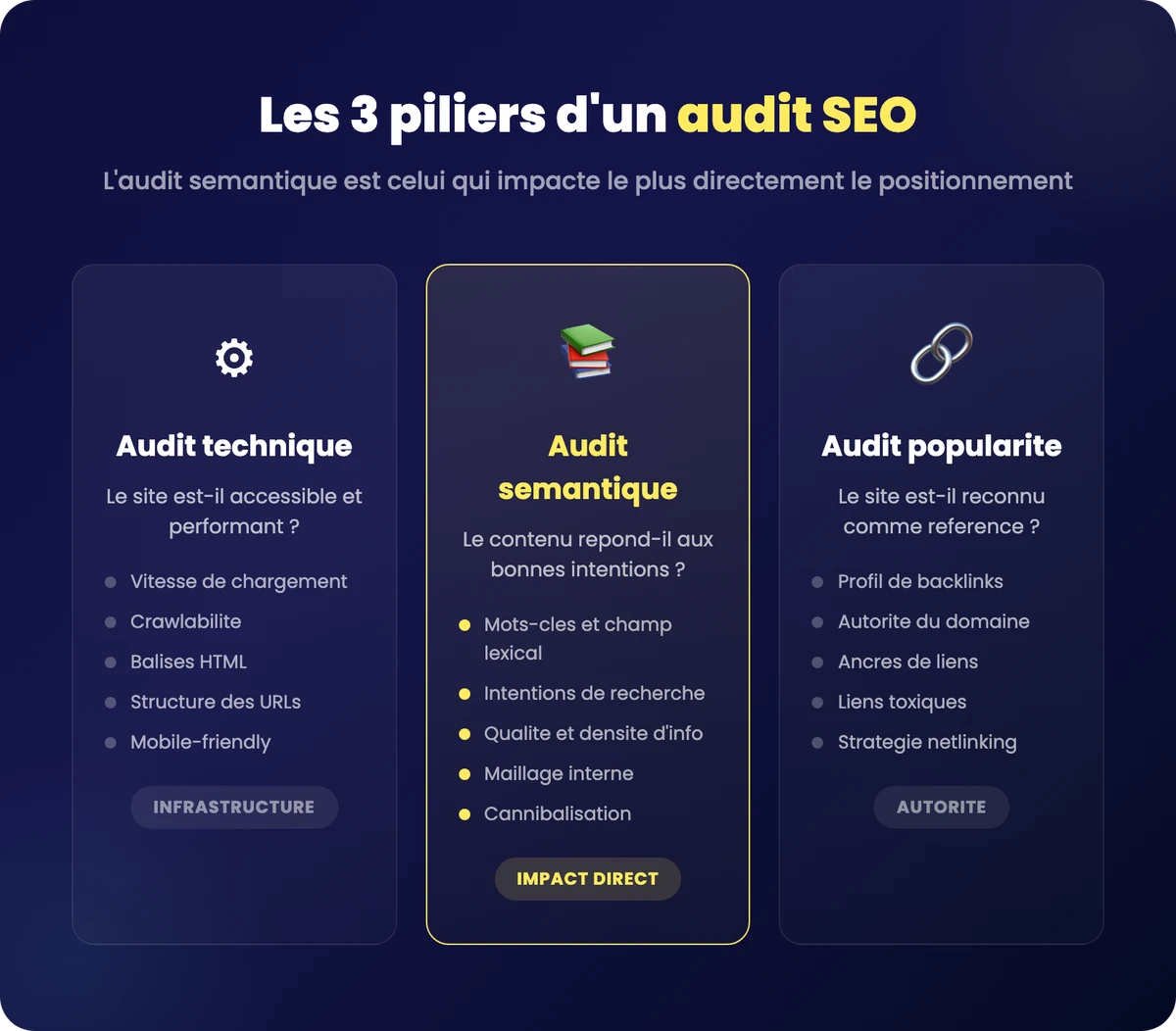
These three analyses are complementary. However, the semantic audit is the one that has the most direct impact on positioning, because Google first evaluates whether your content answers what the internet user is looking for before considering technical or popularity signals.
Why your existing content needs a diagnosis
Content ages faster than you think
An article written 2 or 3 years ago with the best practices of the time might today take your down site. The reasons are manifold: editorial teams changed, guidelines were not documented, the content strategy evolved without the old pages being updated. Add Google's updates (Helpful Content, reinforcement of criteria E-E-A-T) and you get pages that no longer meet current quality standards.
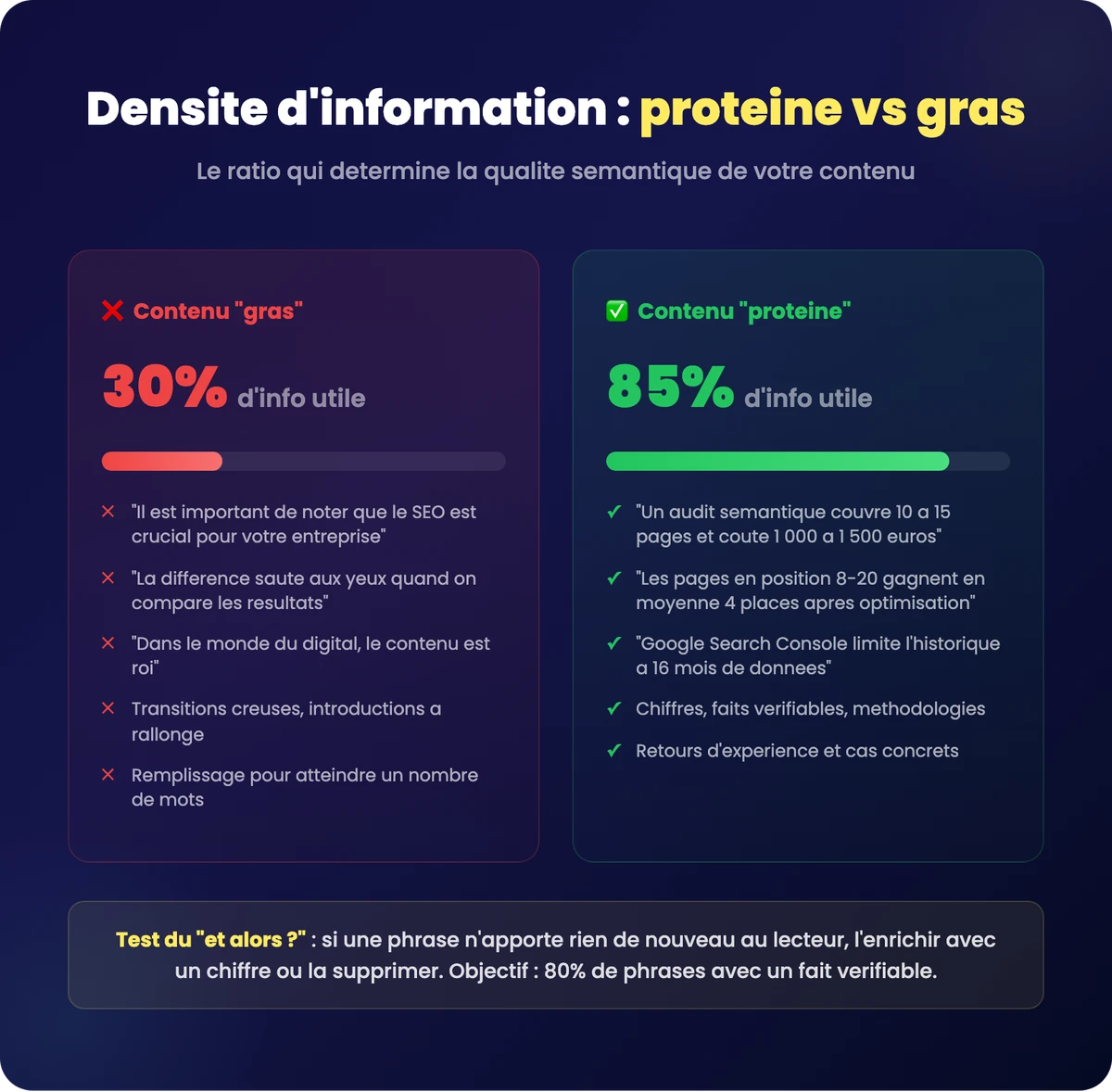
The Information density is an increasingly decisive criterion. Google and generative engines favor content with a high ratio of useful information compared to the total volume of text. This is called the «protein vs. fat» ratio: each sentence should provide a verifiable fact, a figure, a methodology, or feedback from experience. Lengthy introductions, hollow transitions, and filler to reach a word count provide no value. added value and dilute the semantic signal.
Semantic cannibalization: the silent killer of rankings
When two pages on your site target the same query or search intent, Google doesn't know which one to display. As a result, neither of them ranks well. This is the problem of semantic cannibalization, and it is much more common than one might think on sites that have been publishing for a long time.
To detect it, the audit cross-references the data from Google Search Console (which pages appear for the same queries?) with semantic similarity analysis via dedicated tools. Resolution generally involves three options: merging the two pages into more complete content, redirecting one to the other, or clearly differentiating them’search intent targeted by each (informational vs. transactional, for example).
The semantic gaps your competitors are already filling
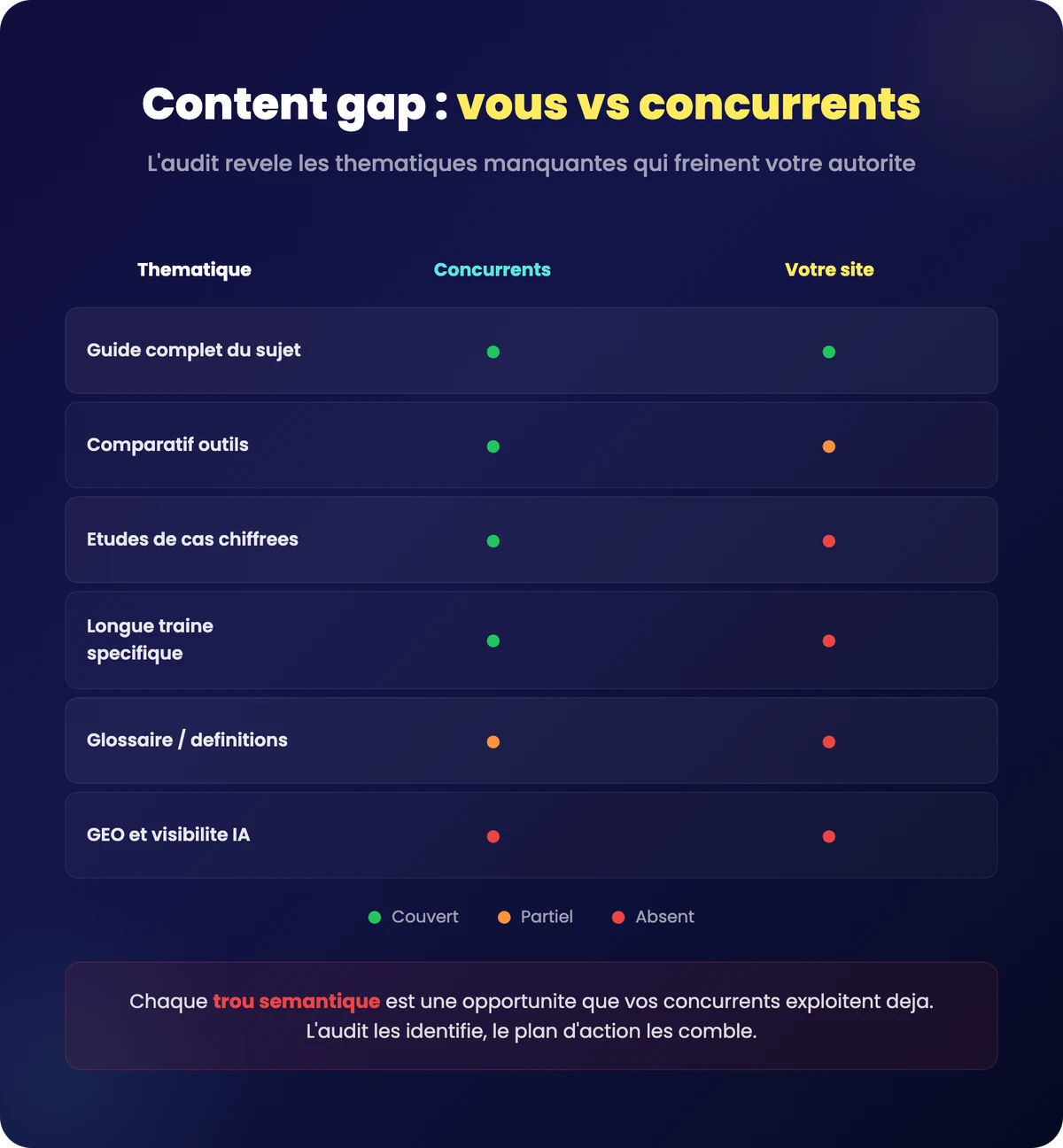
Competitor analysis (content gap) is one of the most actionable deliverables of the audit. It compares your semantic cocoon to those of your market leaders to identify missing themes. These gaps in your semantic coverage hinder your overall authority on the subject and leave the door open for your competitors.
The audit is not limited to high-impact keywords search volume. Expressions of long tail and so-called «zero volume» keywords are often the most profitable: very specific, they meet a precise need of your personas and display conversion rate Clearly superior. A keyword typed 20 times a month by ultra-qualified prospects is often worth more than a generic term with 10,000 monthly searches.
Semantic auditing isn't limited to high-volume keywords. Phrases of long tail and the keywords «zero volume» often have the best conversion rates because they correspond to very specific needs of your targets.

Cover the long tail at scale
Hundreds of pages optimized from your database.
Semantic Auditing in the Era of LLMs and GEO
Why Generative Engines are a Game-Changer
In 2026, SEO is no longer limited to Google. ChatGPT, Perplexity, Google AI Overviews, and SearchGPT draw from web content to generate their answers. This new reality is called GEO (Generative Engine Optimization), and it directly impacts how we evaluate the semantic quality of a site.
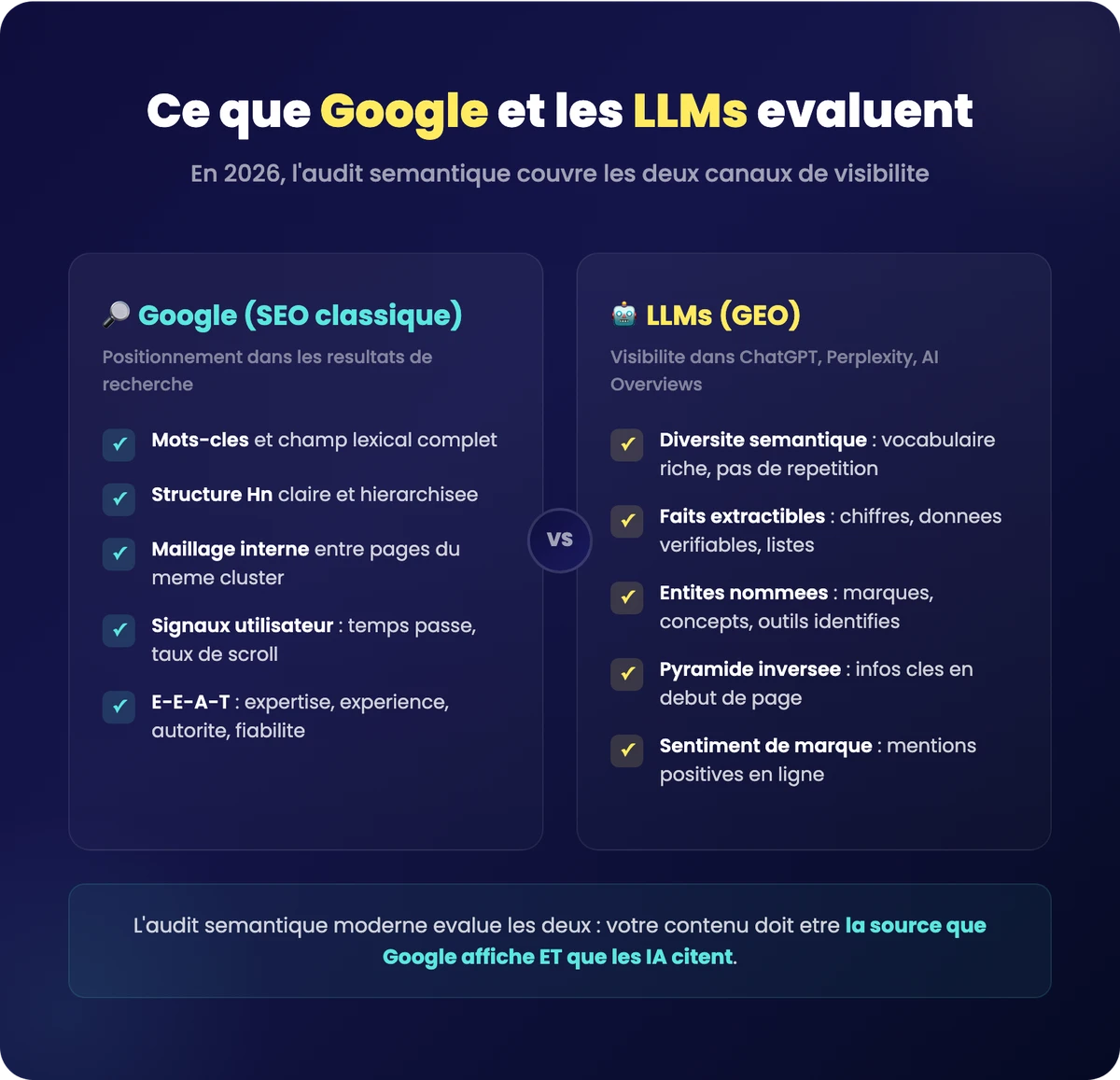
Language modelsartificial intelligenceprefer direct, factual, and well-structured content. They favor the semantic diversity (cover a topic with rich vocabulary rather than repeating the same terms) and the named entities clearly identified (people, brands, concepts, tools). Content that is «to the point,» without stylistic flourishes, is more likely to be cited as a source by AIs than long, diluted text.
How to adapt semantic auditing for GEO
Modern semantic auditing integrates three GEO-specific checks:
-
- Content extractability Are the key pieces of information structured in a way that an AI can easily extract them? Verifiable facts, numerical data, structured lists, comparison tables.
-
- Brand presence in AI responses When you ask ChatGPT or Perplexity about your topics, does your site appear as a source? If not, the audit identifies the levers to achieve this (mentions in reference media, structuring of entities).
-
- Sentiment analysis LLMs analyze how your brand is mentioned online. The audit verifies that these mentions are positive and consistent with your positioning.
The inverted pyramid technique This makes perfect sense: place essential information at the beginning of each page and section. Google may truncate long documents when calculating rankings, and generative engines give more weight to the first paragraphs. A semantic audit verifies that this structure is respected across the entire site.

Be quoted by ChatGPT, Perplexity, and Gemini
60%: Some searches don't require a click. You are selected by AI.
How to perform a semantic audit: concrete steps
Step 1: Map existing content
The first step is to create a comprehensive inventory of indexed pages. Tools like Screaming Frog crawl the entire site to identify each URL, its title tag, its meta description, its Hn structure and its Internal meshing. In parallel, Google Search Console provides a list of pages actually indexed by Google, which allows for identifying discrepancies (unindexed pages, pages indexed in error, Duplicate content).
Each page is then classified by intent: informational (the user wants to understand), commercial (they are comparing), and transactional (they want to buy or contact). This classification immediately reveals imbalances: too many informational pages and not enough conversion pages, or vice-versa.
Step 2: Analyze positions and organic traffic
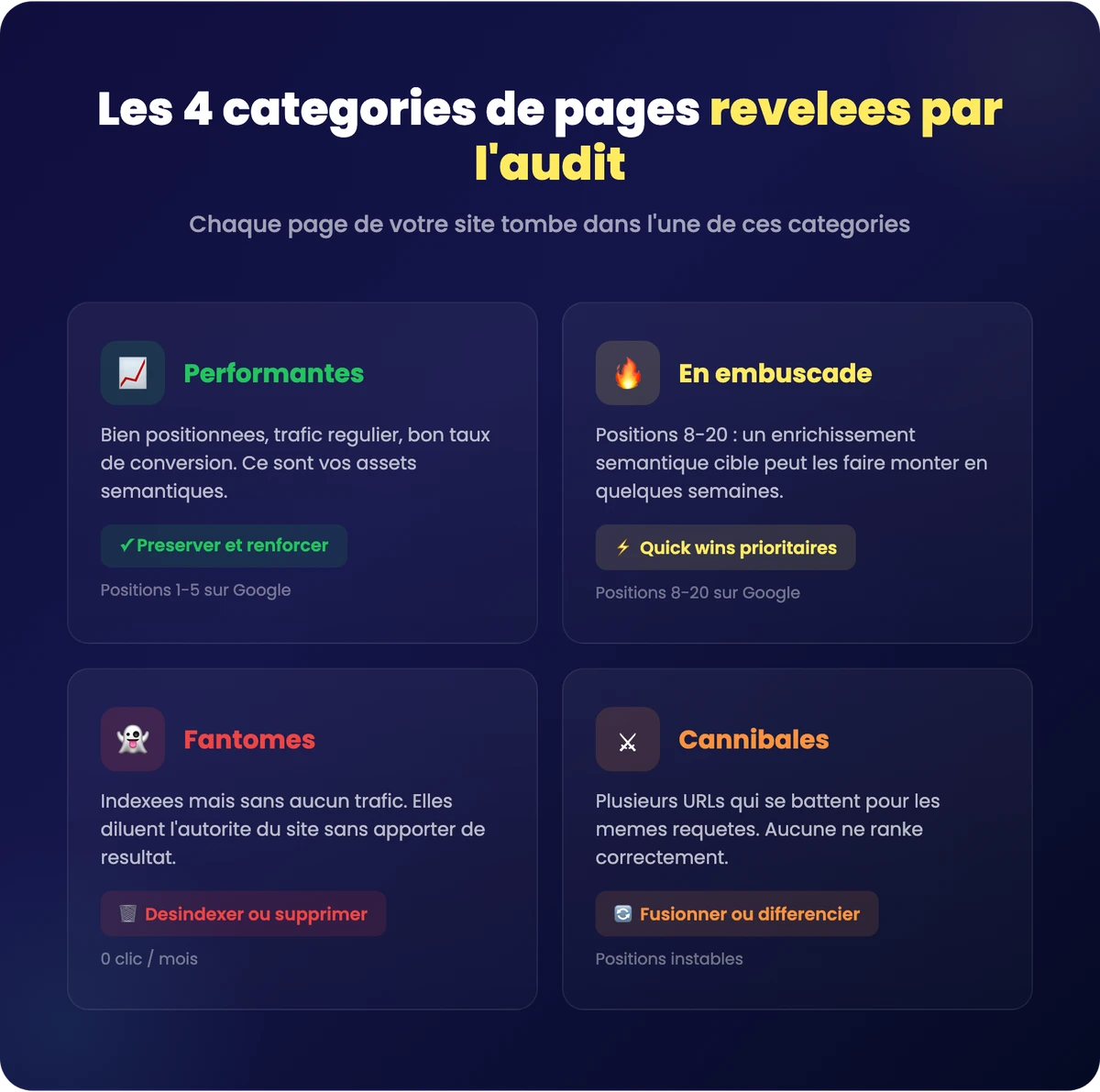
The analysis cross-references positioning data with the organic traffic real. The objective is to identify four categories of pages:
-
- High-performing pages Well-positioned, steady traffic, good conversion rate. These are your semantic assets, to preserve and strengthen.
-
- Ambush pages positioned on page 2 or at the bottom of page 1 (positions 8-20). Targeted semantic optimization can make them rise quickly.
-
- Ghost pages indexed but without traffic. They dilute the site's authority without bringing results.
-
- The Cannibal Pages : multiple URLs competing for the same queries.
The analysis of real queries in Google Search Console often reveals surprises: pages that rank for untargeted keywords (opportunity to exploit) or high-volume queries for which no page is optimized (content to create).
Step 3: Study the competition and content gap
The competitive benchmark compares your semantic coverage to that of the sites dominating your Business sector on Google. For each main keyword, we analyze the top 10: preferred page format, content length, semantic score, number of images, presence of tables.
Tools like Semrush, SEOQuantum or ThotSEO allow you to calculate the semantic optimization score of each competitor page and compare it to yours. The content gap identifies the topics that your competitors cover and that you don't address at all, which hinders the construction of your Topic authority.
Step 4: Evaluate the semantic quality of the content
This is the core of the audit. Each page of the sample (generally 10 to 15 priority pages) is scrutinized from several angles:
-
- Semantic optimization score Does the lexical field used cover the terms expected by Google for this query? Tools like ThotSEO or YourTextGuru calculate this score and list the missing terms.
-
- E-E-A-T Quality Does the content demonstrate real expertise (mastery of technical vocabulary, cited sources)? Does it reflect field experience (concrete examples, feedback from experience)? Is it reliable (no exaggerated promises, verifiable data)?
-
- Information density : what percentage of sentences provides a fact, a figure or an actionable methodology? The goal is a ratio above 80%. Hollow sentences (“The difference is obvious”, “It is important to note that…”) are flagged to be rewritten or removed.
-
- Structure and readability Short paragraphs, descriptive headings, bold for keywords, mobile-friendly content.
-
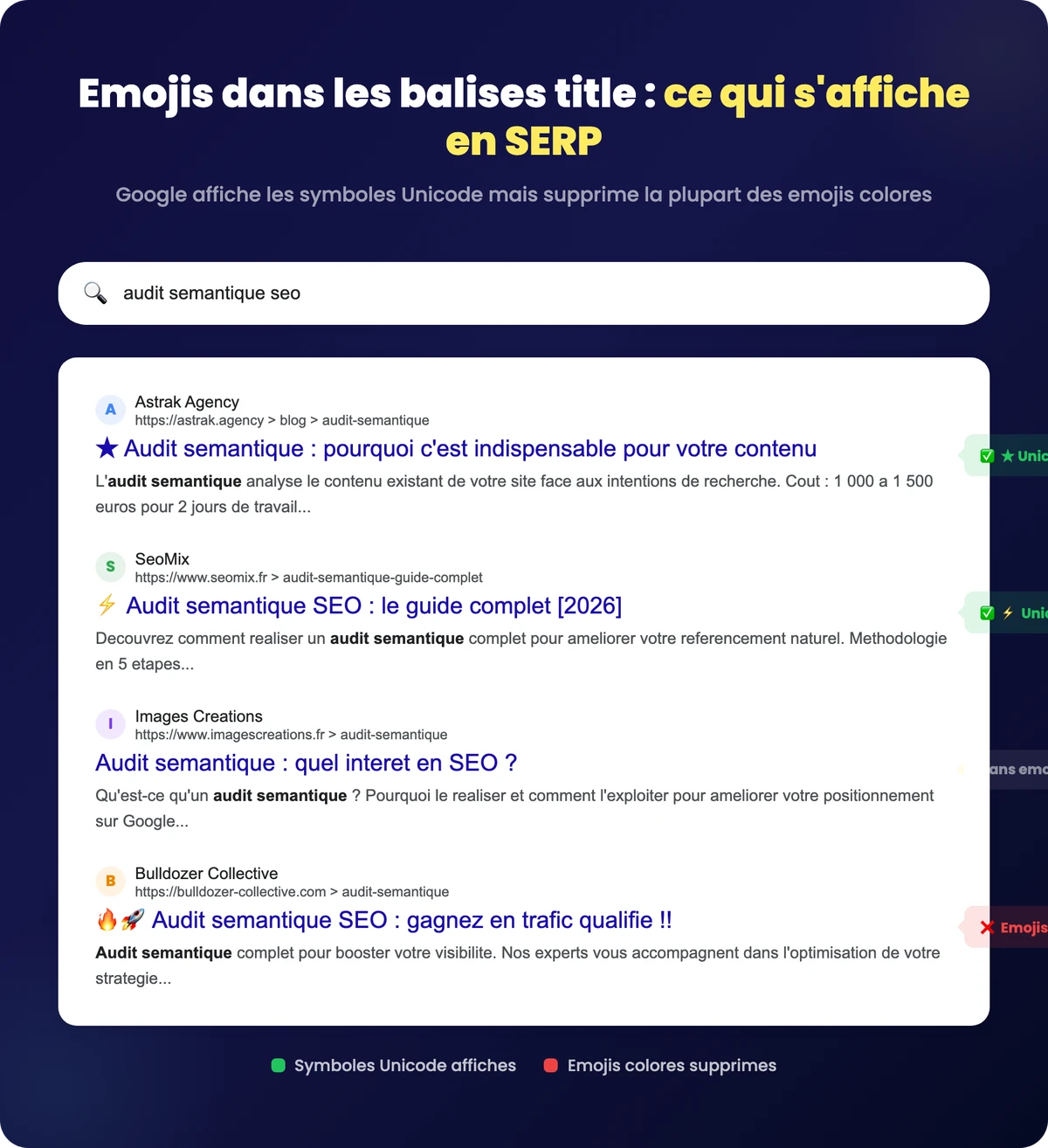
- Title tags and CTR : Is each title tag optimized with the main keyword at the beginning of the tag? Does it stay within the 60-character limit? The audit also checks for the use of Unicode symbols in titles (★, ✓) that can improve the click-through rate by 5 to 12% in SERPs, according to studies by Zyppy. Note: Colored emojis are often removed by Google, while simple Unicode symbols display reliably. Golden rule: use only one symbol per title, at the beginning or end, and always write a title that works without the symbol, since Google’s rewriting system may remove it at any time.
The ThotSEO Content Creation Guide constitutes an excellent checklist for verifying the semantic and editorial quality of each page analyzed.
To evaluate the information density of a page, apply the test of «so what?» read each sentence and ask yourself if it provides new information to the reader. If not, the sentence should be enriched with a figure or a fact, or deleted.
Step 5: Build the Action Plan
Semantic auditing is only valuable if it leads to a Action plan prioritized. The analyzed pages are classified into four intervention categories:
-
- Optimizer Pages lying in wait or semantically suboptimal. Enrich the vocabulary, restructure the Hn tags, improve information density. These are the quick wins.
-
- Create Identified themes in the content gap. New articles or pages to produce to fill the gaps in the semantic cocoon.
-
- Merge Cannibalized pages or fragmented content on the same topic. Group them into a single, more complete, and better-optimized piece of content.
-
- Delete or de-index Ghost pages with no traffic or potential that dilute domain authority.
The plan also includes the restructuring of the Internal meshing according to the defined semantic clusters, and a realistic implementation timeline.
Essential tools for a semantic audit
| Tool | Main use | Force | Limit |
|---|---|---|---|
| ThotSEO | Semantic briefs, optimization score | Fine semantic analysis, precise term suggestions | Focused on content, no technical analysis |
| Google Search Console | Real queries, indexed pages, CTR | Free Google direct data | Limited history of 16 months, no competitive data |
| Semrush | Competitive analysis, content gap, positioning | Massive database, full features | High cost, learning curve |
| Screaming Frog | Crawl technique, page inventory, and tags | Exhaustive site structure analysis | Technical interface, requires expertise |
| SEOQuantum | Semantic clustering, content optimization | Visualization of cocoons, meshing suggestions | Less precise on search volumes |
| YourTextGuru | Semantic Score, Writing Guide | Fast scoring, integrated competitive benchmarking | No overall site analysis |
In practice, a SEO consultant Generally combine 3 to 4 of these tools to cover all audit axes: Google Search Console for actual data, Screaming Frog for crawling, a semantic tool (ThotSEO, SEOQuantum, or YourTextGuru) for content scoring, and Semrush for competitive benchmarking.
How much does a semantic audit cost and what does it include?
The deliverables of a professional semantic audit
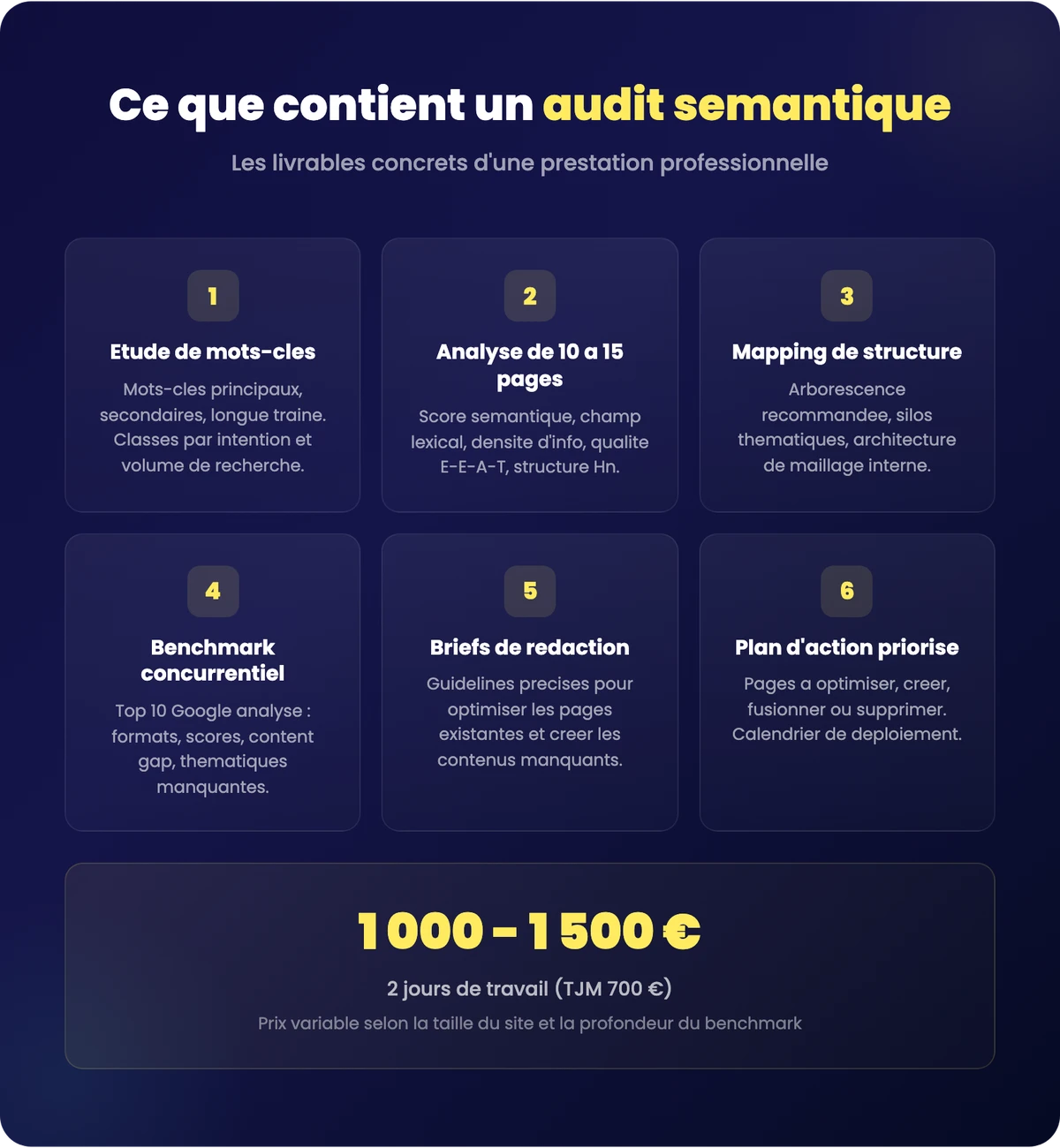
One semantic audit executed by an SEO agency generally includes:
-
- A comprehensive keyword study main keywords, secondary keywords, long-tail keywords, classified by search intent and volume.
-
- A qualitative analysis of 10 to 15 pages Semantic score, lexical field, information density, Hn structure, E-E-A-T quality.
-
- A structure mapping Recommended tree structure, organization in silos or thematic clusters, internal mesh architecture.
-
- Content briefs : precise guidelines for optimizing existing pages and creating new content.
-
- A prioritized action plan : pages to optimize, create, merge, or delete, with a deployment schedule.
Prices and Duration: What to Expect
At Astrak, a semantic audit represents approximately 2 days of work, billed between 1,000 and 1,500 euros Based on a daily rate of 700 euros. This price covers all deliverables listed above.
What can vary the price: the size of the site (an e-commerce site with 500 pages is not handled the same way as a blog with 30 articles), the number of pages to analyze in depth, and the scope of the competitive benchmark. For very large sites, the audit may require a third day of work.
You can find cheaper services from some freelancers, but let's be realistic: below 900 euros per month for comprehensive SEO support, it is difficult to achieve serious results and real growth of qualified traffic. A botched audit that doesn't lead to a concrete action plan is a wasted investment.

A clear diagnosis to unlock your growth
Audit technique, semantic, netlinking, and competition with an action plan.
What to do after a semantic audit?
Semantic auditing is a diagnosis, not an end in itself. Its true impact is measured in the execution of the action plan that follows.
Start with the quick wins ambush pages (positions 8-20) requiring targeted semantic enrichment. Adding missing terms identified by the audit, restructuring Hns, and improving information density can gain several positions in a few weeks.
Next, create the missing content identified in the content gap. Each new piece of content must fit into the semantic cocoon defined by the audit, with a Internal meshing coherent with the pillar pages of each cluster. The goal is to build a Topic authority complete on your sector.
Restructure the internal mesh according to the defined clusters. Internal links should not be random: each link must strengthen the semantic relationship between two pages and guide the user (and Google) in a logical thematic navigation.
Finally, measure the impact at regular intervals: evolution of positions on target keywords, organic traffic growth, improvement of conversion rate by cluster. Semantic auditing is not a one-shot action: quarterly or semi-annual monitoring allows for the detection of new opportunities and continuous strategy adjustment.
For the’content optimization herself, whether it's rewriting existing pages or creating new ones, the ThotSEO Content Creation Guide provides a 7-step framework for producing pages that rank on both Google and in LLM answers.
Semantic auditing is the foundation of any SEO writing strategy high-performance. Combined with a audit technique and a Link building strategy solid, it forms the backbone of a SEO Durable and cost-effective.