


SEO lead generation is about transform organic visibility into concrete business opportunities. In 2026, organic search generates 53 % of the B2B leads incoming and displays a closing rate of 14.6 % versus 1.7 % for outbound. SEO lead cost is 31 $ versus 181 $ for PPC. This guide details targeting strategies, conversion funnels, and scaling techniques for Generate qualified leads through SEO.
You invest in SEO, you gain traffic, but your sales pipeline remains empty. This scenario is common: 67 % B2B companies those who publish content don't have a conversion strategy behind it. Organic traffic without a conversion funnel is like opening a store without a cash register.
In 2026, the SEO lead generation is no longer a vague concept. It is a structured discipline that combines high-intent keyword targeting, conversion rate optimization (CRO), lead magnets, and marketing automation. The data confirms it: SEO delivers a ROI of 748 % in B2B (SeoProfy, 2026) and generates 44,6 % du revenu total B2B.
This guide covers everything: from bottom-funnel targeting strategy to programmatic scaling techniques, including SEO + cold outreach synergy. With numbers, actionable methods, and zero fluff.
Why is SEO the most profitable lever for generating leads?
Before we talk tactics, let's lay out the numbers. SEO surpasses all other acquisition channels in terms of cost per lead and conversion rate.
SEO vs PPC: The Profitability Gap
| Metric | SEO (organic) | PPC (Google Ads) | Ratio |
|---|---|---|---|
| Cost per lead | 31 $ | 181 $ | SEO 5.8x cheaper |
| Closing rate | 14,6 % | 1.7 % (outbound) | SEO 8.6 times more effective |
| Average conversion rate | 2,6 % (B2B) | 1.5 – 2 % | SEO +30 to 73 % |
| Average B2B ROI | 748 % | Variable (CPC increasing) | – |
| Share of B2B traffic | 76 % of trackable traffic | ~15 % | SEO 5x more traffic |
The critical point: the Average CPC Google Ads reached $5.26 $ in 2025, an increase of 12.9 % year-over-year (WordStream). 87 % of sectors saw their CPC increase. The customer acquisition cost has generally increased by 60 % in 5 years. SEO is the only channel whose marginal cost decreases over time: a page that ranks continues to generate leads at no extra cost.
SEO ROI by Sector
Not all sectors benefit from SEO in the same way. Here are the 2026 benchmarks (SeoProfy):
| Sector | Average SEO ROI | SEO Conversion Rate |
|---|---|---|
| Real estate | 1 389 % | 3,2 % |
| Financial services | 1 031 % | SEO 7.3x > PPC |
| Legal services | Raised | 7.5 % (highest) |
| SaaS B2B | 702 % | 2,1 % |
| E-commerce | 317 % | 1.8 – 6.8 % depending on niche |
The commonality among high ROI sectors: a high average order value which justifies long-term SEO investment. To assess the appropriate budget for your sector, consult our analysis on How much does an SEO service cost.
Strategy 1: Target the bottom of the conversion funnel
To generate leads quickly, focus your efforts on high purchase or decision intent queries. This is where the conversion rate is highest.
Reviews, Alternatives, and VS«
These pages intercept final comparison stage for prospects. The user typing «Semrush review» or «Ahrefs vs Semrush» is ready to buy – they're just looking to validate their choice.
The strategy:
- Create your own review pages on your product/service to control the message and redirect traffic to your solution.
- Create «VS» comparisons» between your offer and your competitors. These pages have a high CTR and strong transactional intent.
- Create «Alternative to [competitor]» pages» to capture prospects dissatisfied with the competition.
The «VS» and «Alternative» pages are among the best B2B SaaS converters. A comparison honest and factual (not a competitive bash) converts better than a classic landing page because the prospect is already in decision mode.
Priority transactional keywords to target
Position yourself on specific terms to clear purchase intention is often more profitable than aiming for large volumes of information:
- «buy [product]» : direct purchase intention.
- «[service] + [city]» Local + transactional intent (e.g., «SEO agency Paris»).
- «[product] price» or «[product] rate» Prospect in the budget decision phase.
- «[product] quote» immediate conversion intention.
- «best [product/service]» Advanced comparison phase.
The «zero volume» strategy: targeting the invisible
It's an underutilized lever. the «zero volume» strategy consists of targeting very specific queries that SEO tools do not indicate (0 volume shown in Ahrefs or Semrush).
Why it works:
- SEO tools don't capture all real queries. A keyword showing 0 can very well generate 50 to 200 monthly searches.
- The competition is almost non-existent on these queries, so the positioning is fast.
- Relevance is maximal: these queries often correspond to Very precise personas with an immediate need.
- The conversion rate is much higher that on general, high-volume queries.
To identify these requests: analyze the questions asked by your customers on sales calls, support tickets, specialized forums, and industry Reddit/LinkedIn discussions.
Strategy 2: Using SEO as an Entry Point for a Marketing Funnel
SEO traffic should not be an end in itself. It is the start of a relationship with the prospect. Here is how to structure the tunnel.
Lead magnets and nurturing: capture the email then convert
On content Top of tunnel (informational), the goal is not to sell directly but to capture the email address from a visitor via a lead magnet:
- Free email formation (5-day sequence): the most effective format in B2B. Each email brings value and positions your expertise.
- Specialized Newsletter Weekly exclusive content that maintains the relationship.
- Simulator or calculator interactive tool that solves a concrete problem (e.g., «calculate your SEO ROI»).
- White paper or PDF guide In-depth content in exchange for a form.
- Free audit «Foot-in-the-door» technique particularly effective for agencies and freelancers.
The captured prospect is then worked through... Marketing automation scenarios to gradually lead them toward the purchase. Nurturing transforms a cold visitor into a qualified lead without direct sales action.
67 % of companies rely on content (blogs, eBooks, case studies) to attract and convert leads. Companies that publish 9+ blog articles per month see their Google traffic increase by 35,8 % in one year versus 16.5 % for those who publish 1 to 4 (HubSpot, 2026).
Synergy of SEO and SEA: Test then Sustain
An effective method combines the two channels:
- Testing via SEA Launch a Google Ads campaign on your target keywords to validate conversions quickly (data in 2-4 weeks).
- Identify keywords that convert Analyze which terms generate qualified leads and at what cost.
- Invest heavily in SEO on these validated keywords to ensure acquisition and reduce the cost per lead in the long term.
- Gradually reduce the SEA budget as SEO takes over.
This approach eliminates the risk of producing SEO content for keywords that don't convert. SEA serves as conversion laboratory before long-term SEO investment.
Retargeting: Staying «top of mind» after organic visits
An SEO visitor who doesn't convert immediately isn't lost. The retargeting (retargeting) via social media or display allows you to:
- Stay visible to visitors who have viewed your key pages.
- Bring them back to your site with an offer tailored to their level of engagement.
- Increase the chances of future conversion.
The combo SEO + social retargeting is particularly powerful: SEO captures free qualified traffic, and retargeting converts the undecided for pennies per impression.
Strategy 3: Optimize Conversion Rate (CRO)
Having traffic is useless if the site isn't designed to convert. Conversion Rate Optimization is the essential complement to SEO lead generation.
Navigation and CTAs: The Fundamentals
In B2B or service industries, it is vital to optimize:
- Internal navigation increase pageviews and time spent on the site. These signals are positive for Google (NavBoost) and increase conversion chances.
- Call-to-action (CTA) buttons they must be clear, visible, and strategically placed. A call-to-action (CTA) above the fold converts significantly better than a CTA at the end of an article.
- Forms reduce the number of fields to the bare minimum. Each additional field reduces the completion rate by 10 to 15 %.
User Experience (UX) and Behavioral Signals
The analysis of User signals (click-through rate, retention, pogosticking) has become a predominant ranking factor via Google's NavBoost system. A site that converts well is often a site that Google appreciates because it truly meets the user's needs.
Key UX levers:
- Loading speed : each additional second reduces conversions by 7 % (Google, 2025).
- Mobile-first : over 60 % of traffic is mobile. If your contact form is unusable on a smartphone, you lose the majority of your potential leads.
- Information Architecture The visitor must find the answer to their question in less than 3 clicks.
- Social proof Customer reviews, brand logos, case studies visible on conversion pages.
For a complete technical optimization of your site, check out our technical SEO offer.

Lift the technical brakes holding back your SEO
Indexing, speed, JS, schema, crawl: we're unlocking it all.
Strategy 4: Scaling
Once the lead generation machine is in place, how do you multiply the results?
Programmatic SEO: Thousands of Automated Pages
For businesses that can generate thousands of data-driven pages, programmatic SEO is a lever for exponential scaling:
- Directories and diaries : ex: «flea market in [department]» x 101 departments = 101 localized pages.
- Technical data sheets Each product or service broken down by variant, locality, or specification.
- Automated Comparison Pages «[product A] vs [product B]» for each competitor combination.
Programmatic SEO allows for exponential traffic growth with a reduced content investment a unique template used on hundreds of pages. The challenge is to ensure that each page brings unique value (local data, reviews, prices) to avoid duplicate content.

Cover the long tail at scale
Hundreds of pages optimized from your database.
Local SEO: the #1 lever for local services
For local services (plumber, lawyer, restaurant, real estate agency), the optimization of Local SEO is the first lead generation lever:
- Optimized Google Business Profile Listing Photos, schedule, description with keywords, precise categories.
- Google reviews collection The number and quality of reviews are the #1 factor for local pack. Each additional review increases visibility.
- Consistent NAP citations Name, address, phone number identical on all directories (PagesJaunes, Yelp, industry directories).
- Localized pages : one page per targeted city/neighborhood with unique content.

Capture customers searching near you
Master "[service] + [city]". Calls, visits, real clients.
Rank and Rent: Renting Your Rankings
Advanced strategy: positioning a website in a ultra-competitive request (e.g., «plumber [city]», «car insurance») then rent the position to a third-party company for a monthly flat fee. This is the «Rank and Rent» model:
- You are creating a website optimized for the target query.
- You position it on the first page via SEO + link building.
- You are renting out the website (or the generated leads) to a local business.
It's a form of lead generation where You don't sell an SEO service, but rather already acquired positions.. The business model is simple: a monthly flat fee or a commission on leads generated.
The profit-sharing model
For SEO providers, an effective lead generation method is to offer a revenue-sharing or profit-sharing partnership generated by SEO traffic. This model:
- Make it easier to close new clients (no risk for them).
- Aligns provider and client interests.
- Generate recurring and growing revenue.
Strategy 5: The SEO + Cold Outreach Combo
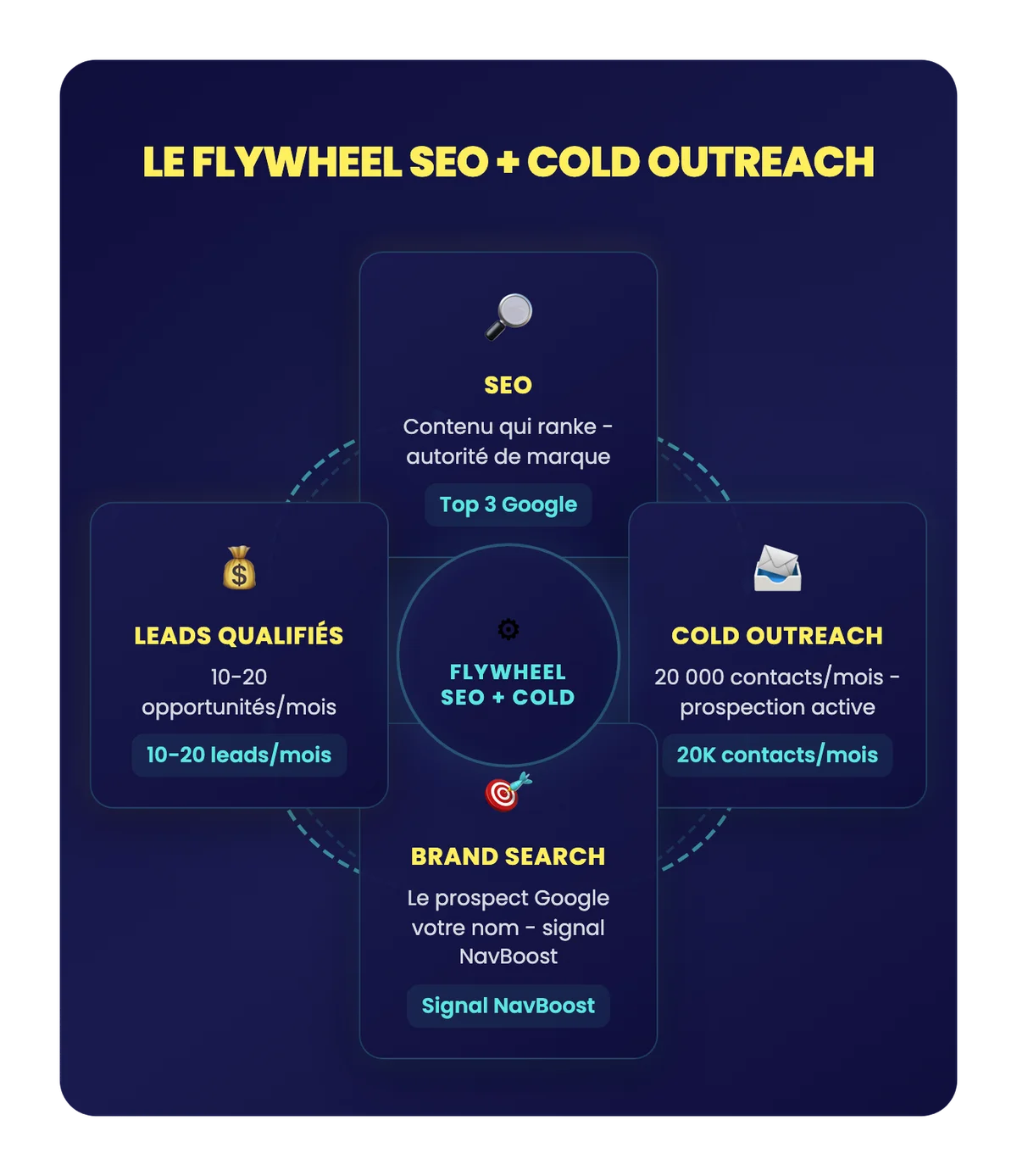
The coupling of SEO with campaigns cold emailing Create a multiplier effect on lead generation.
Volume and automation
The SEO + cold email combo generates between 10 to 20 real business opportunities per month if the offer is well validated. The process:
- SEO attracts qualified traffic and position your brand as an expert.
- Cold emailing actively prospects companies matching your persona.
- SEO notoriety makes cold emailing easier When a potential client Googles your name and finds quality content on the first page, your response rate increases.
Massive cold emailing campaigns (up to 20,000 contacts per month) work when coupled with a strong organic presence. Cold email without SEO credibility is spam. Cold email backed by brand authority visible on Google is intelligent prospecting.
Qualified Sourcing: Where to Find Contacts
- Apollo LinkedIn lead generation with verified emails.
- Scrap IO Extraction of Google Business Profile listings for local businesses.
- LinkedIn Sales Navigator targeting by role, industry, company size.
- Your Own SEO Traffic Identify companies visiting your site via reveal tools (Clearbit, Leadfeeder) and prospect them directly.
The branding effect of cold email on SEO
Cold emailing has a positive side effect on SEO: it stimulates branded research« (brand name searches). When a prospect receives an email and Googles your brand, it generates an authority signal that Google captures via NavBoost. The more your brand is searched for, the more legitimacy Google grants you, which indirectly boost the overall SEO of the site.
The SEO mistakes killing your lead generation
Error 1: Traffic without a conversion strategy
Generate 10,000 monthly visits to informational articles without CTAs, forms, or lead magnets = 0 leads. Each page must have a clear conversion goal, even if it's simply capturing an email.
Error 2: Targeting the wrong keywords
Focusing only on high-volume informational keywords («what is SEO») without covering transactional queries («SEO agency [city]», «SEO quote») is like filling the top of the funnel without ever converting at the bottom.
Error 3: Ignore the user experience
A site that loads in 5 seconds, with a 12-field form on mobile, loses 90 % of its potential leads. UX is not a «nice to have,» it's the foundation of conversion.
Error 4: No post-visit nurturing
A visitor who doesn't convert on their first visit isn't lost – provided you follow up. Without email capture + nurturing + retargeting, you're losing 97 % of your traffic definitely.
Essential Tools for SEO Lead Generation
| Category | Recommended tools | Usage |
|---|---|---|
| Keyword research | Ahrefs, Semrush, our recommended SEO tools | Identify high-intent queries |
| SERP Analysis | Semrush, Ahrefs, Google Search Console | Understanding Competition and Opportunities |
| CRO and analytics | Google Analytics, Hotjar, Microsoft Clarity | Analyze behavior and optimize conversion |
| Marketing automation | HubSpot, Mailchimp, ActiveCampaign | Nurturing and automated email sequences |
| Cold prospecting | Apollo, Lemlist, La Growth Machine | Cold emailing and multi-channel sequences |
| Reveal visitors | Clearbit, Leadfeeder, Albacross | Identify companies that visit your website |
| SEO technique | Screaming Frog, Sitebulb | Technical audit and crawl |
SEO lead generation in 2026 is a complete system high-intent keyword targeting, conversion-focused content, nurturing funnels, and scaling through programmatic advertising or cold outreach. Companies that treat SEO as just another traffic channel are missing out 76 % of their B2B acquisition potential. Those that connect it to a real conversion strategy turn every Google listing into qualified leads machine.